Egyptian texts name more than 1,400 gods across some three thousand years, and the best known today are Ra, Osiris, Isis, Horus, Set, Nephthys, Thoth, Anubis, Hathor, Bastet, Sekhmet, Ptah, Amun and Maat. Their roles shifted with the period and the city, and gods often merged, as in Amun-Ra.
Around 700 BC, King Shabaka of the Twenty-fifth Dynasty (whose reign is dated variously, now often to about 705-690 BC) had a text cut into a great slab of stone. The inscription says why: he had found an ancient scroll, eaten by worms, and he did not want it to be lost. The text describes the god Ptah creating through his heart and his tongue, by thinking and then speaking. How old that scroll really was is one of the great arguments of Egyptology, and proposed dates range from the earliest dynasties to the Twenty-fifth Dynasty itself.
The Shabaka Stone is a good place to start, because it shows two things about the Egyptian gods at once. Their stories were worth saving, and we are never quite sure how old they are.
There is no official list
Nobody in ancient Egypt drew up a roster of "the main gods." There was no holy book and no authorized version of the myths. What we know is pieced together from temple walls, tombs, papyri and inscriptions made over thousands of years, during which new gods appeared, old ones faded and the characters of the gods were never neatly fixed.
Even the count is debated. Reference works commonly speak of about 1,500 named deities, Allen estimates more than 1,400, and Leitz says "thousands upon thousands." So the fourteen names in the opening paragraph are a modern editor's choice, a selection of the figures a reader is most likely to meet. It is not an Egyptian canon. Here is that selection, with what each is known for.
| God | Known for | Where to read more |
|---|---|---|
| Ra (Re) | The sun god; by the Fifth Dynasty one of the most important gods; fused with Amun, Horus and Atum | Ra’s Night Journey and the Serpent That Wanted to Stop the Sunrise |
| Osiris | Lord of the dead, and a god of fertility and vegetation; first attested in the Fifth Dynasty, and prominent in the Pyramid Texts | Isis and Osiris: The First Murder Mystery |
| Isis | A member of the Ennead and a central figure in the Osiris story | Isis and Osiris: The First Murder Mystery |
| Horus | Part of the Osiris story; fused with Ra as Ra-Horakhty | Isis and Osiris: The First Murder Mystery |
| Set | A god whose reputation swung from honored to demonized | See "When a god changes sides" below |
| Nephthys | A member of the Ennead; in some periods the mother of Anubis | Why Is Anubis a Jackal? (He May Be a Wolf) |
| Thoth | The god linked with writing | Thoth and the Invention of Writing (and Why Socrates Disliked It) |
| Anubis | An early funerary god, shown as a jackal or a canine | Why Is Anubis a Jackal? (He May Be a Wolf) |
| Bastet | Shown first as a lioness; the cat came later | Bastet and the Cats of Ancient Egypt: Why They Were Sacred |
| Sekhmet | A lioness goddess; a Middle Kingdom text sets her against those who transgress | See "Gods by job" below |
| Ptah | The creator of the Memphite Theology, working by heart and tongue | See "Gods by job" below |
| Amun | Appears in the Ogdoad; fused with Ra as Amun-Ra | See "Fusions" below |
| Maat (Ma’at) | Cosmic order, personified as a goddess | See "Gods by job" below |
Hathor, named in the opening paragraph, has no row in the table.
Families of gods
Egyptian priests liked to arrange gods in groups, and each group belonged to a place.
The best attested is the Ennead, the "Nine," associated with Heliopolis. It is in the Pyramid Texts, so it is certainly as old as the Fifth Dynasty. A list there gives Atum, Shu, Tefnut, Geb, Nut, Osiris, Isis, Set and Nephthys. Atum's earliest record is also in these texts. Membership was not rigid: some versions include Horus the Elder. The Ennead matters because it puts the gods of the Osiris story into one family tree with the gods of the sky and the earth.
The Ogdoad, the "Eight," of Hermopolis needs more care. The full group is not an Old Kingdom fact. The earliest certain reference to the Ogdoad is Hatshepsut's inscription at the Speos Artemidos in the Eighteenth Dynasty, and some scholars argue that the group is a later construct. The French scholar Christiane Zivie-Coche gave her study of the group a title ending "ou l'invention d'un mythe" ("or the invention of a myth"). The line-up also varied: at Hibis, in the Twenty-seventh Dynasty, Amun and Amunet were replaced by Kerh and Kerhet. The males are shown frog-headed and the females snake-headed. So call it a tradition that was shaped over time, not a family that always existed.
Memphis offers a different kind of theology, in which Ptah is the creator. That is the doctrine on the Shabaka Stone, and its dating is contested. The stone itself is of the Twenty-fifth Dynasty. As for the text, Breasted at first placed it no later than the early Eighteenth Dynasty, though he later argued for a Pyramid Age date. Erman, Sethe, Junker and Frankfort chose the first five dynasties, and Grimal, in 1988, argued for the Old Kingdom. Friedrich Junge, in 1973, found no philological grounds for an Old Kingdom date. We should not call it an Old Kingdom text as if that were settled.
Thebes is the home of Amun, the god who rose to the top when his worshippers' city did. For how his rise worked, see the section on fusions below.
These systems are rivals as well as relatives. Heliopolis, Hermopolis and Memphis each told how the world began in its own way, and the Egyptians did not feel they had to choose one.
Gods by job
Sorting by function helps, as long as we remember that most gods had several.
Creation. Atum in the Heliopolitan tradition, the Ogdoad at Hermopolis and Ptah at Memphis are three different answers to the question of how everything began. Ptah's answer is unusually abstract: the world exists because it was conceived in the heart and spoken by the tongue.
The sun. Ra was among the most important gods by the Fifth Dynasty. His story is a daily journey and a daily danger, told in Ra’s Night Journey and the Serpent That Wanted to Stop the Sunrise.
Death. Osiris rules the dead, and he is also tied to fertility and vegetation, which is why the dead and the crops belong in the same story. Anubis is the older funerary god, and Isis and Nephthys belong to the same circle. The way a soul passes through all this is described in The Journey to the Afterlife in Egyptian Mythology. Be careful with one popular idea: Osiris is not the sun god and Isis is not a moon goddess.
Writing. Thoth is the god tied to scribes and the written word, with his own story in Thoth and the Invention of Writing (and Why Socrates Disliked It).
Protection. Lioness goddesses guard the king and the land. A Twelfth Dynasty text, the "Loyalist Teaching," calls the king "Bastet who protects the Two Lands" and Sekhmet against those who transgress. The same fierce protection can be seen in both names.
Order. Maat is both a principle and a goddess, and the Egyptians did not separate the two. From the Fifth Dynasty, viziers bore the title "priest of maat." You will find modern lists of "the seven principles of Maat" or "42 laws of Maat" online, but the seven principles do not appear in ancient texts and are a modern adaptation. Do not read them as Egyptian doctrine.
Why a human body and an animal head?
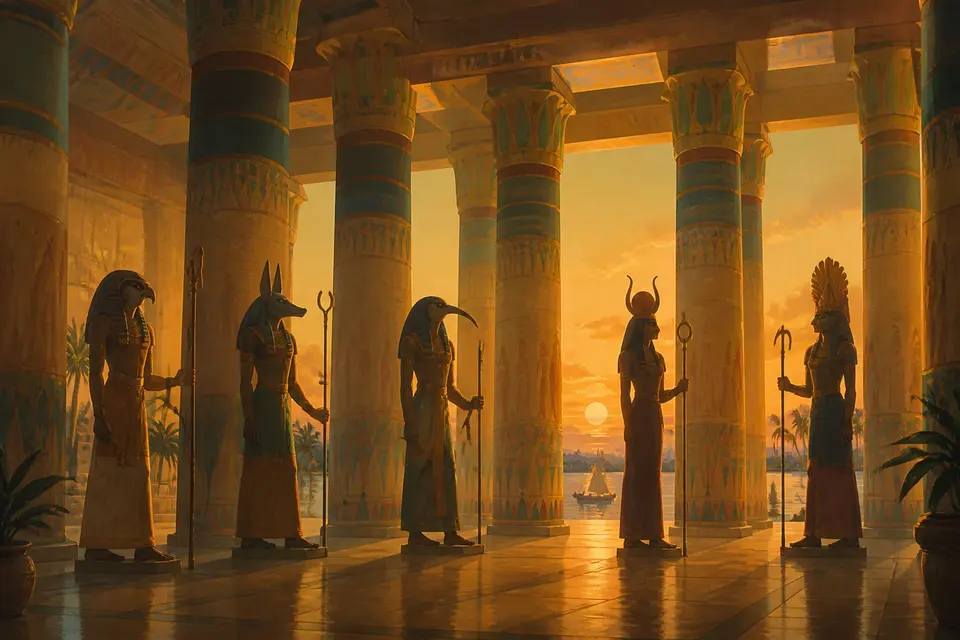
The best-known feature of Egyptian gods in art is the mix of a human body with the head of an animal: Anubis the jackal, Thoth the ibis, Sekhmet the lioness. It is tempting to think that Egyptians pictured their gods like this, or worshipped animals as animals. The evidence does not support that.
Egyptian art showed gods in many forms, from fully human to fully animal to composite ones. Richard Wilkinson calls the human-bodied, animal-headed ones "bimorphic," and notes that the head is consistently the essential element (a point he takes from Henry Fischer). In Fischer's formulation, a lion-headed goddess is a lion-goddess in human form, while a royal sphinx is a man who has assumed the shape of a lion. Erik Hornung is read as arguing that these figures are a kind of ideogram: a way of showing a deity's attributes, not a portrait of how the deity looked.
There are limits to what we can say. No ancient Egyptian text explains the convention, so "the head shows the nature and the body the action" is modern scholarly interpretation. Greek visitors, who took such images literally, got it wrong, and Plutarch condemns animal worship near the end of his work on Isis and Osiris. That polemic is Greek. It is not what Egyptians said about themselves.
When a god changes sides
One of the biggest mistakes is to treat "the Egyptians believed" as a single statement. The gods changed.
Set. His name is first attested in the Pyramid Texts. Second Dynasty kings such as Peribsen, who used a Set title instead of a Horus name, and Khasekhemwy, who used both Horus and Set, expressed their kingship through the god. The Coffin Texts and the Book of the Dead show him in a mixed light. In the Ramesside period kings honored him, and Seti I even bore his name. Only in the Late and Graeco-Roman periods was he openly demonized. When that shift began is disputed: some say the Third Intermediate Period, some the Twentieth Dynasty, others the Twenty-fifth or Twenty-sixth. Set was not always the evil god.
Anubis. He is a funerary deity already named in the Pyramid Texts. By the Middle Kingdom Osiris had replaced him as lord of the underworld. His parentage also varies by source and period: Ra, Nephthys and Osiris, Set, or in other accounts Bastet or Isis. That is why "Anubis is Osiris's son" cannot be stated as timeless fact.
Bastet. From her earliest records until the later New Kingdom she is shown exclusively as a lioness. The cat is a later development, and exactly when the shift happened is debated. The fuller story is in Bastet and the Cats of Ancient Egypt: Why They Were Sacred.
Fusions
Egyptian gods did not stay in separate boxes. The pairing of Amun with Ra is the famous case. Modern scholars call this syncretism. UCL's Digital Egypt guide notes that it undercuts our assumption that every name is a separate character. Ra was also combined with Horus as Ra-Horakhty and with Atum. Jan Assmann's book Re und Amun (1983) studies how this affected the polytheistic worldview in the Eighteenth to Twentieth Dynasties.
So when you read "Amun-Ra," do not picture two gods holding hands. Picture one divine power that a priesthood wanted to describe through two names, and that the Egyptians were comfortable having both ways.
How we know any of this
The oldest religious texts are the Pyramid Texts, carved in royal and queenly pyramids from the end of the Fifth Dynasty through the Sixth Dynasty and beyond. The earliest known copy is in the pyramid of Unas, in the late 24th century BCE. The texts are probably older than that copy, but how much older is debated, and the figures of "3000 BCE" that you may see online have no secure basis. They were reserved for royalty and were not illustrated.
The Coffin Texts, from about 2100 BCE, carried such spells to others. The Book of the Dead appeared in the early New Kingdom, and by about 1450 BC its spells were written on papyrus scrolls. Most of them can be traced back to the earlier two collections. Our access to the gods, in other words, runs through funerary writings, temple inscriptions and later copies.
The best-known telling of the Osiris story is not Egyptian at all. Plutarch wrote De Iside et Osiride around 120 CE, addressed to Clea, a priestess at Delphi. It mixes Middle Platonic philosophy with real information about Egyptian cult. It is the most extensive Greek view of Egyptian religion, but by no means an accurate source of data, and he even tells Clea (chapter 11, 355B) not to think the tales of wanderings and dismemberments literally happened. He also identifies Set with the Greek Typhon. It is a Hellenized, Platonizing account. For the details of the myth itself, see Isis and Osiris: The First Murder Mystery.
If you came for the supposed curses on tombs, that is another matter, with its own story in The Curse of the Pharaohs: Where the Legend Really Began. And if you want to compare with other pantheons, there are guides to The Twelve Olympian Gods: Who They Are and How They Are Related and The Norse Gods: Who Is Who in Asgard and Beyond.
Quick answers
- What is the Egyptian word for "god"? Nṯr (feminine nṯrt). Its origin is obscure, and the etymologies scholars have proposed have gained no acceptance.
- How big is the oldest spell collection? The pyramid of Unas holds 283 spells in the Pyramid Texts. The Book of the Dead, whose Egyptian name is "Spells for Going Forth by Day," has about 200.
- Are the names we use Egyptian? Mostly Greek forms. Osiris comes from the Greek form of wsjr, Isis from the Greek form of a name written ꜣst, and Anubis from the Greek form of Inpu. Hieroglyphs do not record vowels, so the original pronunciation is uncertain.
- Did Greeks recognize Egyptian gods? Yes, in their own terms. Herodotus already equated Osiris with Dionysus, a habit called interpretatio graeca. It tells us how Greeks saw Egypt, not how Egyptians saw their gods.
What we rely on
Ancient sources
- The Pyramid Texts (inscribed in royal and queenly pyramids from the end of the Fifth Dynasty onward; the earliest copy is in the pyramid of Unas, late 24th century BCE).
- The Coffin Texts (from about 2100 BCE) and the Book of the Dead (early New Kingdom onward).
- The Shabaka Stone (Memphite Theology), Twenty-fifth Dynasty. Discussion and translated extracts by Leonard H. Lesko, "Ancient Egyptian Cosmogonies and Cosmology," appear in Byron E. Shafer (ed.), Religion in Ancient Egypt: Gods, Myths, and Personal Practice (Cornell University Press, 1991).
- The "Loyalist Teaching" (Twelfth Dynasty), which calls the king Bastet and Sekhmet.
- Plutarch, De Iside et Osiride (about 120 CE). Edition, translation and commentary: J. Gwyn Griffiths, Plutarch's De Iside et Osiride (University of Wales Press, 1970). Translation: Frank Cole Babbitt, Moralia V (Loeb Classical Library, 1936).
Modern scholarship
- Erik Hornung, Conceptions of God in Ancient Egypt: The One and the Many, translated by John Baines (Cornell University Press, 1982).
- Richard H. Wilkinson, The Complete Gods and Goddesses of Ancient Egypt (Thames & Hudson, 2003).
- Richard H. Wilkinson, "Anthropomorphic Deities," UCLA Encyclopedia of Egyptology (2008).
- Geraldine Pinch, Egyptian Mythology: A Guide to the Gods, Goddesses, and Traditions of Ancient Egypt (Oxford University Press, 2002).
- Jan Assmann, The Search for God in Ancient Egypt, translated by David Lorton (Cornell University Press, 2001).
- Jan Assmann, Re und Amun: Die Krise des polytheistischen Weltbilds im Ägypten der 18.-20. Dynastie (Orbis Biblicus et Orientalis 51, Fribourg and Göttingen, 1983).
- Christiane Zivie-Coche, "L'Ogdoade d'Hermopolis à Thèbes et ailleurs ou l'invention d'un mythe," Egitto e Vicino Oriente 39 (2016): 57-90.