The Greeks believed Asclepius could raise the dead because their myths made him the best physician who ever lived: a god's son, trained by the centaur Chiron and handed a miraculous drug by Athena. Most versions say he went one step too far, brought people back from Hades, and was killed by Zeus's thunderbolt. Then the Greeks built hospitals-in-a-temple in his name, which tells you how seriously they took the story.
Who was Asclepius, and why did a centaur raise him?
In the most common version, Asclepius is the son of Apollo and a mortal woman, Coronis, daughter of Phlegyas. A raven told Apollo that Coronis had taken another lover, Ischys. Apollo turned the bird black, and Coronis died. In Apollodorus' Library, the god snatched the baby from her burning pyre and carried him to Chiron, who taught him healing and hunting. Pindar's third Pythian ode tells it the same way, with Artemis striking Coronis down. Ovid has Apollo shoot her himself.
Chiron was the right teacher. He was the wise centaur who also raised Achilles, according to the Roman-era Astronomica ascribed to Hyginus. So Asclepius grows up as a mortal child with a divine father, a mother who died young, and the best medical education in the Greek world.
What did Athena's Gorgon blood do?
This is the part that explains the resurrections. Apollodorus says Asclepius became so skilled at surgery that he could raise the dead, and that Athena had given him the blood from the Gorgon's veins. He used the blood from the left side to harm and the blood from the right side to save, and with the second he restored life.
It is not the only version. In Euripides' Ion, Athena gives two drops of Gorgon blood to Erichthonius, an early king of Athens, and again one drop heals and the other kills. A story about a Gorgon's blood therefore existed without Asclepius. Other writers skip the blood entirely. In the Astronomica ascribed to Hyginus, Asclepius sees one snake bring a herb that revives another and uses the same herb on a dead man. That text adds that the usual credit for this trick goes to the seer Polyidus.
Whom did Asclepius bring back to life?
The ancient lists do not agree. Apollodorus gives several names, each with a different authority: Capaneus and Lycurgus (from Stesichorus), Hippolytus (from the Naupactica), Tyndareus (from Panyasis), Hymenaeus (from the Orphics) and Glaucus, son of Minos (from Melesagoras). Pausanias says it was Hippolytus, and the local tradition at Aricia adds that the revived prince refused to forgive his father Theseus. Ovid's Fasti also names Hippolytus. Philodemus, quoting Telestes and Cinesias, says Zeus killed Asclepius for reviving Hippolytus at Artemis' request, while Stesichorus' Eriphyle names Capaneus and Lycurgus instead.
The pattern is clear, even if the names are not. The Greeks kept returning to the same few mythical dead men and attached Asclepius' great act to whichever one a poet or a city preferred.
Why did Zeus kill Asclepius with a thunderbolt?
The sources give different reasons.
- Money. Pindar says Asclepius was bribed with gold to revive a man who was already dead, and Zeus struck both of them down. Stesichorus is cited for the same gold. Plato, in the Republic (408b), reports this story and then rejects it as unworthy of a god's son.
- Fear of what people might learn. Apollodorus says Zeus feared that humans would acquire the healing art from Asclepius and help one another.
- A complaint from the underworld. Diodorus Siculus (4.71) has Hades protesting that the number of the dead was dwindling.
- A warning. Aeschylus, in the Agamemnon, says only that Zeus destroyed Asclepius to teach that the dead are not to be raised.
- No reason at all. A fragment of Hesiod records the lightning bolt and Apollo's anger, and gives no motive.
Whichever reason you pick, the lesson is the same: the boundary between life and death belongs to the gods. A mortal, even a god's son, who crosses it is punished.
What happened to Apollo and to Asclepius afterward?
Apollo was furious. According to Apollodorus, he killed the Cyclopes who had forged Zeus's thunderbolt. Zeus meant to hurl him into Tartarus, but at the request of Apollo's mother Leto he ordered Apollo to serve a mortal for a year instead. Apollo went to Admetus at Pherae and worked as his herdsman. Diodorus and Hyginus tell this too.
Asclepius, for his part, did not stay dead. Diodorus says Zeus placed him among the stars at Apollo's request, and the Astronomica identifies him with the constellation of the Serpent-Holder, Ophiuchus. So in the end he is both a punished mortal and a heavenly figure.
How did the Greeks worship Asclepius at Epidaurus?
The myth turned into a cult, and the cult is better documented than most. The great sanctuary of Asclepius at Epidaurus was already known in the sixth century BC, according to one account, and its fame peaked in the fourth. Pausanias also records a local claim that Asclepius was born there rather than in Thessaly, and he mentions three different mothers in his sources, which shows how contested the story was even in antiquity.
What the sick did there is called incubation. After purification, offerings and baths, they slept in a large dormitory, the enkoimeterion or abaton, hoping the god or his daughters Hygieia and Panacea would visit in a dream. Priests interpreted the dreams and prescribed treatment. Three stone slabs dated to about 350 BC list the names, complaints and cures of roughly seventy patients, including some surgical ones. Dogs and harmless snakes moved among the sleepers.
The sanctuary also had a guest house with 160 rooms, and a theatre by Polykleitos the Younger that seated up to 14,000 after Roman additions. UNESCO inscribed the site in 1988. Asclepius cults spread to Athens, Kos, Pergamon and Rome. Even the original Hippocratic Oath invoked him, along with Apollo, Hygieia and Panacea.
Why does the Rod of Asclepius carry a snake?
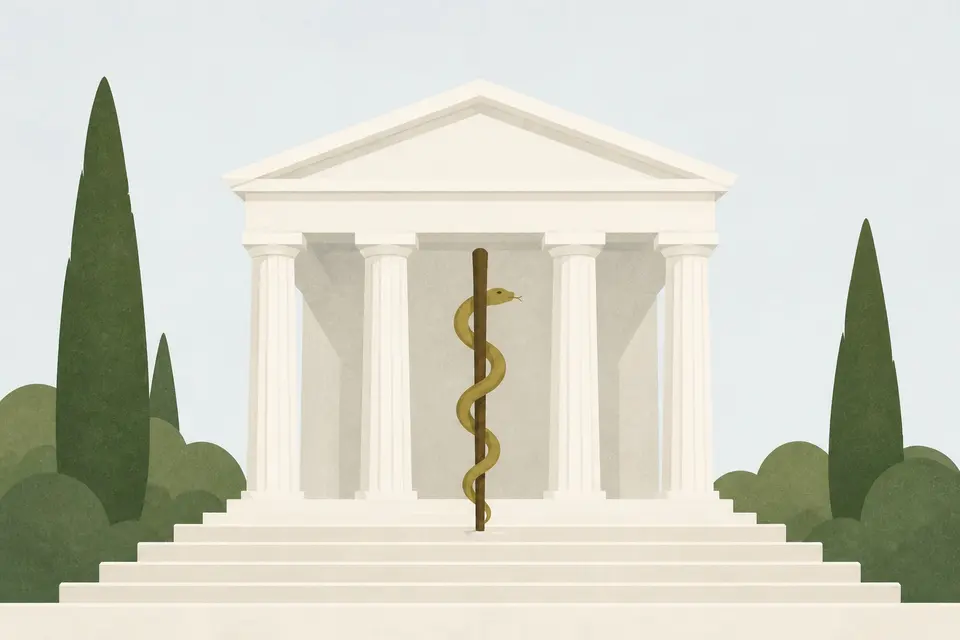
Pausanias describes the statue at Epidaurus as showing the god with a staff and a serpent, and a dog beside him. The rod of Asclepius, one snake around a plain staff, is the symbol still used by medical organisations. It is often confused with the caduceus, the winged staff of Hermes with two snakes.
Why a snake? Nobody knows for certain. A snake sheds its skin, which suggests renewal. The Greek word pharmakon meant both medicine and poison, and a snake can stand for both. The real snakes of the cult were Aesculapian snakes, non-venomous and gentle enough to be let loose in the dormitories. Both explanations are modern readings, not ancient statements.