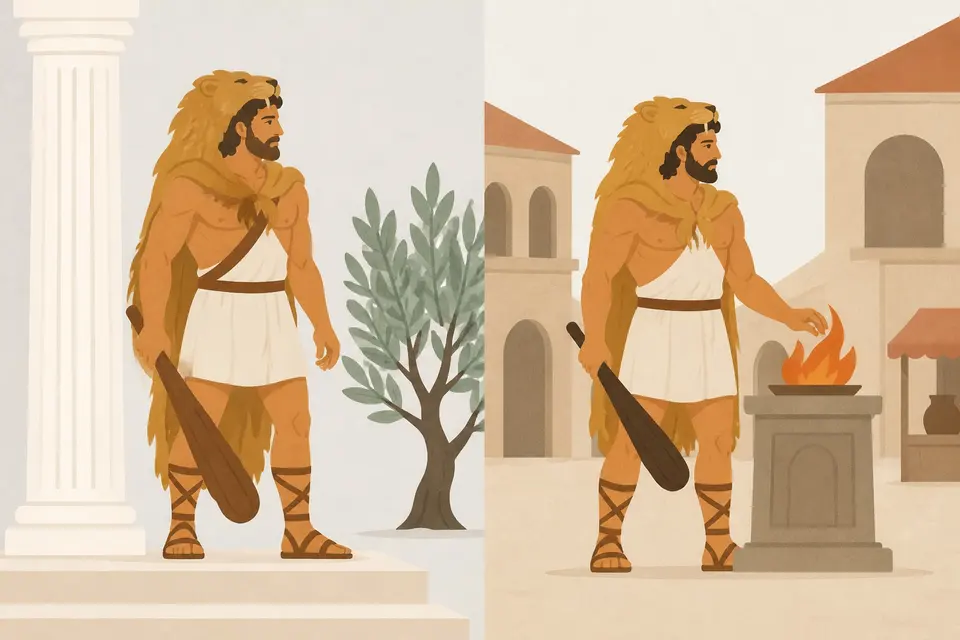
If you ask what separates Heracles from Hercules, the short answer is a language and a century of habits. Hercules is the Latin form of the name, and the hero is the same man with the same club and lion skin. But once the Romans took him in, they changed what he was for.
What stayed the same between Heracles and Hercules?
The Greek stories came first. Heracles is the son of Zeus and a mortal woman, Alcmene. He is a hero of enormous strength, driven mad by the goddess Hera, who makes him kill his own family and then does the twelve labors as penance. At the end of his life he dies in pain and is taken up among the gods. The Romans kept all of that. Their Hercules is the son of Jupiter, the Roman Zeus, and he performs the same labors, which you can read in why Hercules really had to do the twelve labors. The name itself reached Rome through the Etruscans, who said Hercle.
What the Romans added
A cult of his own. Rome had one of the oldest and strangest Hercules cults in the Mediterranean. Its center was the Great Altar of Hercules, the Ara Maxima, in the Forum Boarium, Rome's cattle market. The rites followed the Greek manner, with the head uncovered, and women were excluded. A family tradition looked after it until the Roman state took over its upkeep in 312 BC.
A Roman legend. Rome told a story that the Greeks never did. On his way home with the cattle of Geryon, one of his labors, Hercules passed the site of future Rome. A fire-breathing cave dweller named Cacus stole some of the cattle and dragged them backward into his cave so the tracks would mislead. Hercules heard the cattle lowing, broke into the cave and killed Cacus. The grateful locals then set up the altar. The tale is told at length in Virgil's Aeneid, where Hercules becomes a founding hero for Rome.
New jobs. In Rome he was invoked as a protector in many places the Greek hero had no link to. Sources mention him as a patron of gladiators, of quarries and of baths. He became "Hercules Invictus," the unconquered, and later emperors, such as Commodus, compared themselves to him.
How did the Greek Heracles differ in tone?
In Greece, Heracles had an uneasy, human side. He is tormented, he makes terrible mistakes, and he suffers. Greek tragedy, such as Euripides's Heracles, spends its time on that pain. The Roman version is usually calmer and more civic: a powerful protector who clears away monsters and defends order.
Why did Rome adopt a Greek hero?
Borrowing a foreign hero was normal in the Roman world, and Hercules fit Rome's habits well. He was strong, he was a victor, and he stood for effort that is rewarded. Generals and later emperors liked the comparison. The Romans also liked a story that connected their city to a famous Greek hero: with the legend of Cacus, Hercules had already been on the hill where Rome would stand, and the city's oldest cult could claim him as its guest of honor.
For the wider picture of how Rome reused Greek gods, see Greek and Roman gods, side by side. It helps to remember that Roman religion was practical. A god received an altar, a festival and a promise in exchange for a service, and Hercules was good at services: protection on the road, success in business, victory in the arena. That is a different mood from the tormented hero of the Greek stage.
How to tell them apart in a story
- Heracles (Greek): a flawed, suffering hero, centered on the labors and on his atonement.
- Hercules (Roman): a protector figure, linked to the Ara Maxima, the legend of Cacus and public life.
- Both carry a club and wear the skin of the Nemean lion.
The short version: a Greek hero and a Roman protector
Seen together, the two names tell one story from two points of view: the Greek one about a human life measured in suffering and triumph, and the Roman one about a strong guardian that a city could pray to.
The Romans did not replace the Greek hero. They adopted him and gave him a Roman address, a Roman monster to defeat and Roman tasks to look after.