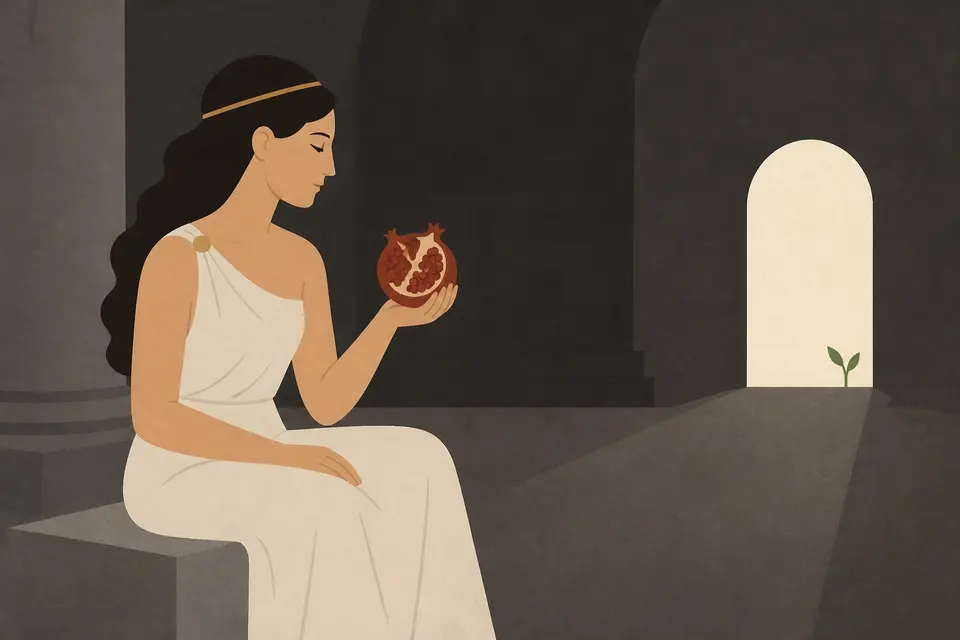
When Persephone ate the pomegranate seeds, she could no longer leave the underworld for good. In every ancient version, the seeds bind her to Hades and force a compromise: she spends part of each year below with him and the rest above with her mother Demeter and the other gods. What changes from author to author is almost everything around that result: whether she chose to eat, how many seeds there were, who found out, and how long she has to stay.
Did Persephone eat the seeds on purpose?
It depends on who is telling the story. The oldest full version, the Homeric Hymn to Demeter, says Hades "secretly" gave her a sweet pomegranate seed to eat just before she left. When Persephone describes it to her mother, she says he put the food in her mouth and forced her to taste it against her will. Here she is tricked and pressured, not careless.
The mythographer Apollodorus, whose handbook of myths is a short catalogue of the stories, gives Hades the active role too: he gave her a seed to eat "in order that she might not tarry long with her mother." The motive is plain. Hades wanted a reason for her to come back.
Ovid, the Roman poet writing in the Metamorphoses, tells it differently. His Proserpina (the Latin form of the name) wanders the gardens of the underworld and picks a pomegranate herself. She does not know what it will cost her. The seed is no longer a trap set by Hades but an innocent snack with a heavy result.
How many seeds were there?
The Greek sources give one. The Hymn and Apollodorus both say "a seed." Ovid is the source of the number seven: his Proserpina "chewed seven grains" from the pale rind of the fruit. A modern retelling that gives another number is following a different tradition, so it is worth checking which version it uses.
The count matters less than the principle. Even a single seed counts as eating in the realm of the dead. Ovid has Ceres (the Roman Demeter) set on bringing her daughter home, and then adds the line that it cannot happen, because "the Fates" do not permit it once she has eaten.
Who told on her, and what happened to him?
Not every source has a witness. The Hymn has none, since Persephone herself reports the seed. Apollodorus and Ovid both name one: Ascalaphus, a figure of the underworld, whom Apollodorus calls the son of Acheron and Gorgyra. He saw (or "bore witness" to) the eating, and that testimony closed the way back.
His punishment differs by author. In Apollodorus, Demeter laid a heavy rock on him in Hades. In Ovid, it is Persephone, now queen of the underworld, who turns him into a bird, the owl, which Ovid calls a sad omen for humankind. The owl version is the one most readers remember, and it is the only one of the two that needs a transformation.
How long does she have to stay?
The two oldest Greek accounts agree on a third of the year. In the Hymn, the agreement is that she goes down "for the third part of the circling year," and spends the other two parts with Demeter and the gods. Apollodorus says she was compelled to remain "a third of every year" with Hades and the rest of the time with the gods.
Ovid changes the split. Jupiter, acting as mediator between his brother and Ceres, divides the year into equal parts, so Proserpina reigns in two kingdoms, six months in each. This is why you will find both "a third" and "half" in books and online. The Greek texts say a third, and the half comes from Ovid. Neither is a mistake, but they are different tellings.
What did the seeds make her?
The seeds do more than set a calendar. In the Hymn, after the reunion, the goddess Hecate becomes Persephone’s "minister and companion," which marks her as a ruler with her own court rather than a prisoner. Ovid has a nymph, Arethusa, describe her as the mighty "queen consort" of the king of the dead, and in the final division of the year she reigns over two realms.
So the pomegranate marks a change in status as much as a punishment. A girl picked flowers in a meadow. A goddess who belongs to two worlds came back. That is why the fruit, with its sweet and blood-colored seeds, stays so tightly attached to her image.
Sources
- Homeric Hymn to Demeter, lines 370 to 470 (Perseus Digital Library).
- Apollodorus, Library 1.5.3 (Theoi.com).
- Ovid, Metamorphoses 5 (Theoi.com).