Zeus overthrew Cronus because Cronus's own fear started the war. In Hesiod's Theogony, Cronus swallowed his children to avoid a prophecy that a son would overthrow him, and the child who escaped, Zeus, won the war as fated payback for his family.
What was the prophecy?
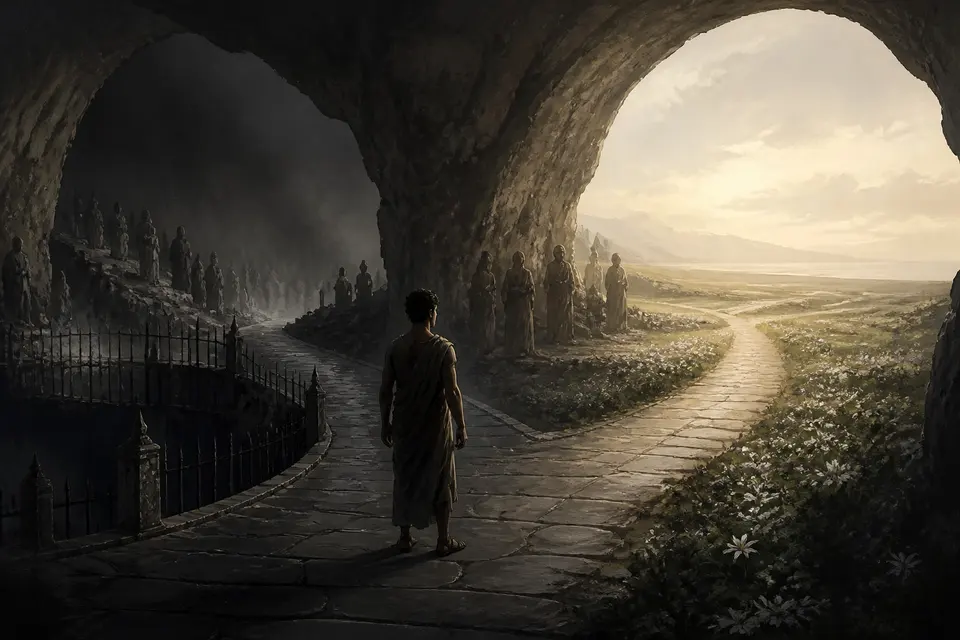
Hesiod says Cronus swallowed each child as it was born so that no other son of Uranus (Uranus, the sky) would hold kingship among the gods. He had learned from Gaia (Earth) and Uranus that he was destined to be overcome by his own son, through the contriving of great Zeus (Theogony 459-465).
Notice what the prophecy says: a son will overcome him. The swallowing was Cronus's own response, and it is what turned a warning into a feud.
The prophecy also repeats history. Cronus had won the kingship by castrating and deposing his own father (Theogony 154-210). He feared a son would do to him what he had done to Uranus.
Was Zeus ambitious, or was this revenge?
Hesiod never gives Zeus a motive such as ambition. The poem treats his victory as fated and as redress.
When Rhea was about to give birth to Zeus, she asked Gaia and Uranus for a plan to hide the birth, so that retribution would overtake Cronus for his own father and for the children he had swallowed (Theogony 468-473). The question is framed less as why Zeus wanted power and more as why Cronus deserved to lose it. For where Zeus sits afterward, see The Twelve Olympian Gods: Who They Are and How They Are Related.
How did Zeus escape being swallowed?
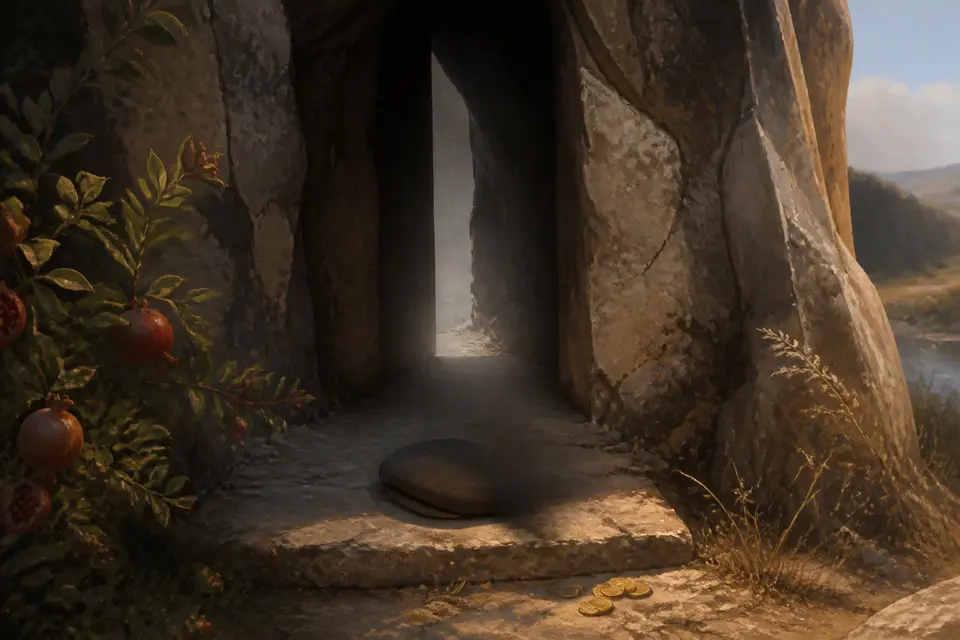
Rhea wrapped a large stone in a baby's blanket and handed it to Cronus, who swallowed it (Theogony 485-491). In Hesiod, Gaia hid the newborn Zeus in a cave under Mount Aigaion, near Lyctus on Crete.
Later, tricked by Gaia's cunning advice, Cronus disgorged his children, beaten by the skill and strength of his son. Zeus set the stone in the ground at Pytho (Theogony 492-500).
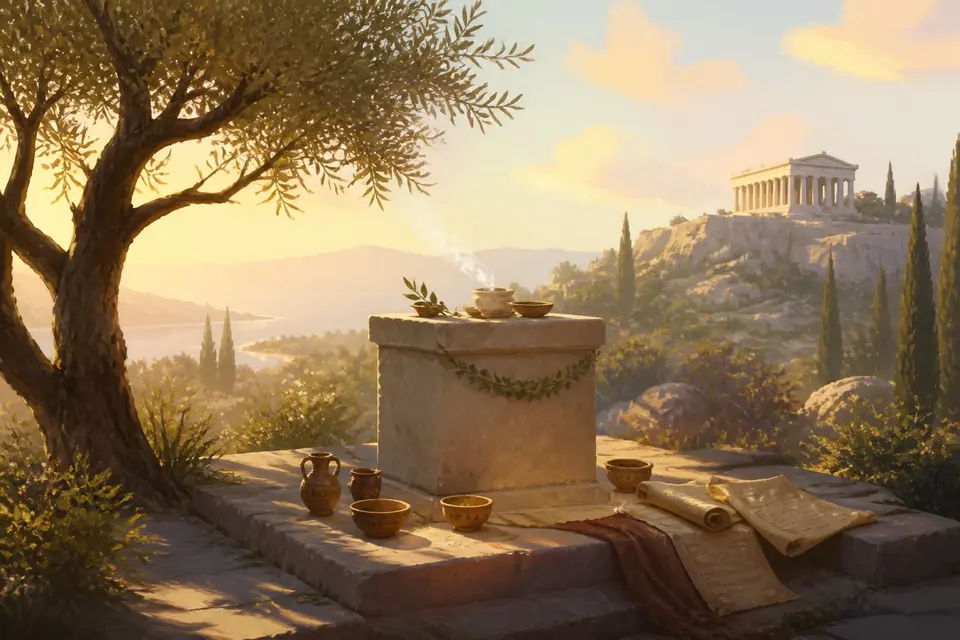
That stone had a real afterlife. Pausanias (10.24.6) reports that a small stone at Delphi was anointed with oil every day, and wrapped in white wool on solemn occasions, and that people believed it was the stone Cronus swallowed. The report is Pausanias's; the identification is a Delphic belief. For the sanctuary itself, see The Oracle of Delphi: Who Spoke for Apollo?.
How did Zeus win the war?
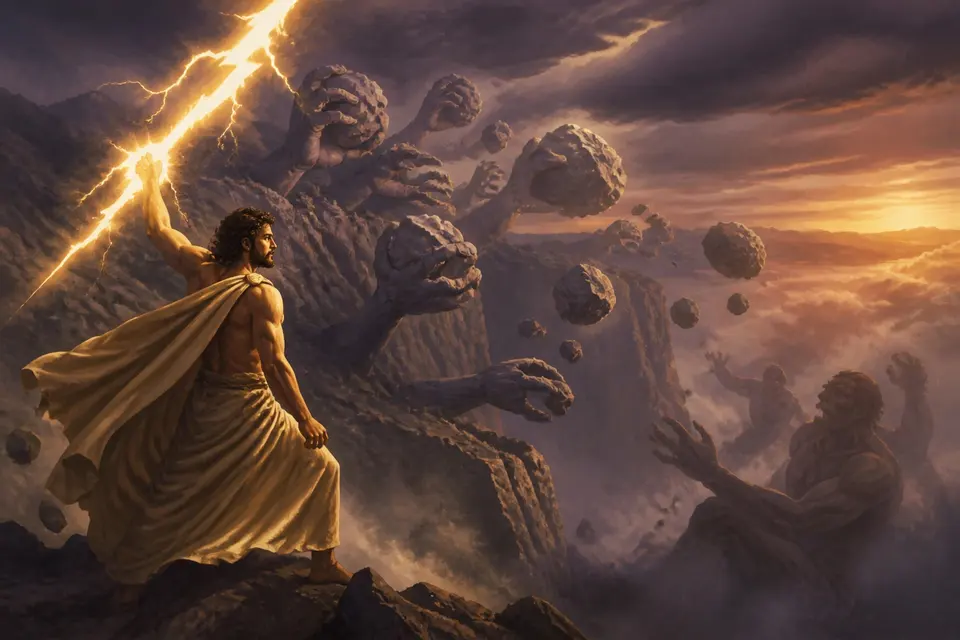
Hesiod says Zeus freed the Cyclopes, who gave him thunder, lightning and the thunderbolt (Theogony 501-506). The war between the gods and the Titans then lasted ten years (636).
The turning point was another set of prisoners. Uranus had bound the three Hundred-Handers, Cottus, Briareos and Gyes, jealous of their size and strength, and made them live beneath the earth. On Gaia's advice, the gods brought them back up to the light (Theogony 617-653).
They decided the fight. They hurled three hundred rocks at once, buried the Titans under missiles and sent them beneath the earth in bonds (713-721). Poseidon set bronze gates over the prison, and the Hundred-Handers stayed as Zeus's faithful guards (729-735). For a Titan who took Zeus's side, see Prometheus: The Titan Who Stole Fire (and Inspired Frankenstein).
What did later writers change?
The best-known addition is the emetic. In Apollodorus's Library (1.2.1), Zeus takes Metis, daughter of Ocean, as helper, and she gives Cronus a drug that makes him vomit up the stone and then the children. Hesiod does not mention Metis or a drug here; he credits Gaia's advice. Apollodorus is generally believed to be a compilation of the 2nd century AD, far later than Hesiod. Apollodorus also has Cronus re-bind the Cyclopes and Hundred-Handers under the guard of the dragoness Campe (1.1.5, 1.2.1). Hesiod does not clearly say Cronus re-imprisoned them, and Campe is not in the Theogony.
Even Zeus's birthplace moves. Later sources name Dicte or Ida, with the Curetes and nymphs nursing him. The lost Titanomachy, attributed to Eumelus or Arctinus, reportedly set his birth in Lydia, probably at Mount Sipylus, according to the Byzantine writer Lydus. Its authorship and date are debated. M. L. West argues it is too late for Eumelus. The fragments suggest it differed from Hesiod. For example, a scholiast reports that "Eumelus" made Aegaeon a sea-dwelling ally of the Titans.
Did Zeus kill Cronus?
Not in Hesiod, whose Titans are imprisoned, not killed. Cronus's own fate is thinly told. A badly damaged passage of Philodemus's On Piety (Stesichorus fr. 274A) mentions Stesichorus alongside Hesiod and Apollonides in connection with Cronus being thrown into Tartarus. The text is fragmentary and its interpretation is uncertain.
Cronus is also not Chronos, "Time." That reading is later allegory, not classical myth.
Where does the story come from?
The pattern of a father deposed by his son, who is then deposed in turn, resembles the Hurrian-Hittite Kumarbi cycle, the Song of Kingship in Heaven. Scholars accept a Near Eastern connection in broad terms but debate how it was transmitted. A different tale of a younger god defeating older powers is Tiamat and Marduk: The Babylonian Story of How the World Was Made. Hesiod's Zeus also answers to fate, as The Three Fates Who Even Zeus Obeyed explains.
Is the Kraken part of this story?
No. The Kraken is Scandinavian, popularised by Bishop Erik Pontoppidan's Natural History of Norway (1752-53). It does not appear in Greek myth. The link comes from the film Clash of the Titans (1981), where Laurence Olivier as Zeus says "Release the Kraken." In the film, the Kraken takes the place of Cetus, the sea monster of the Andromeda myth. The line is film dialogue, not an ancient or Norse saying.
What we rely on
Ancient sources
- Hesiod, Theogony 147-210, 453-506, 617-653, 713-735. Translation: M. L. West, Theogony and Works and Days (Oxford World's Classics, Oxford University Press; first published 1988, reissued 2008).
- Pseudo-Apollodorus, The Library 1.1.5 and 1.2.1. Translation: J. G. Frazer (Loeb Classical Library).
- Pausanias, Description of Greece 10.24.6 (the stone at Delphi).
Modern scholarship
- M. L. West, ed., Hesiod: Theogony (Clarendon Press, 1966): commentary, including the Near Eastern parallels.
- M. L. West, The East Face of Helicon: West Asiatic Elements in Greek Poetry and Myth (Oxford, 1997).