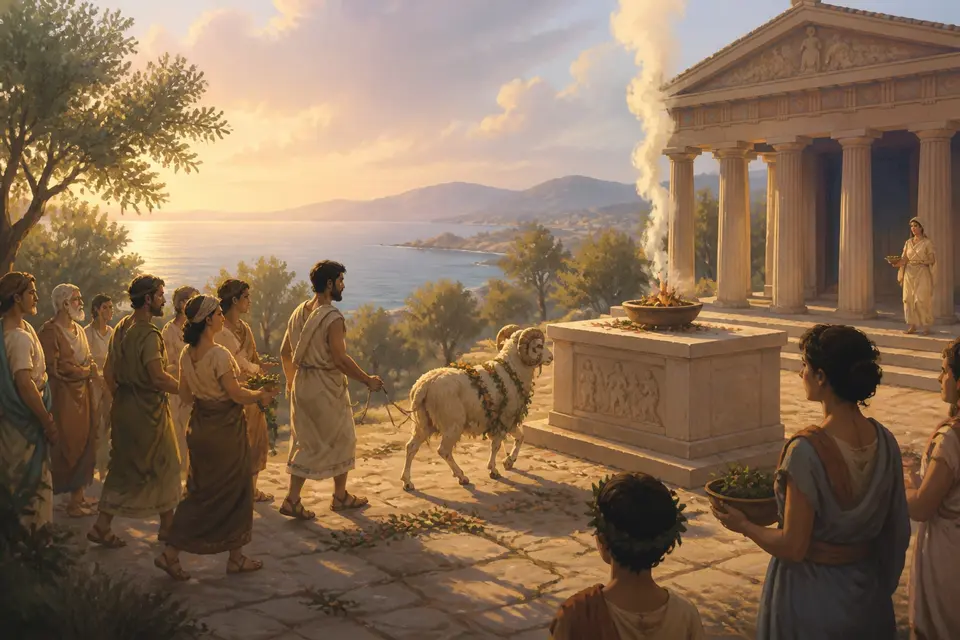
Hades is called Hades because that is his Greek name, Aïdēs, and what it originally meant is still debated. The ancient guess was "the Invisible," and many modern linguists lean the same way. Aidoneus is a poetic variant, while Plouton (Pluto) is a different title, meaning giver of wealth.
What does the name Hades mean?
Homer's form is Áïdēs, with poetic variants such as Aïdōneús and inflected forms like Áïdos. The meaning was already a puzzle for the Greeks.
In Plato's Cratylus (403a), Socrates says most people think Hades is a name of the Invisible (aeidēs), which is why they fear him and prefer to call him Pluto. Socrates then offers a different derivation: the god is named for his knowing (eidenai) everything fine and beautiful. Plutarch (De superstitione 13) briefly echoes Plato's explanation, that the god is called Hades because he is wise and humane and also rich, but it does not set out the "Invisible" derivation alongside it. Whether Socrates is serious is debated, since the dialogue ends up rejecting the study of words as a poor road to truth.
Modern scholars are not agreed either. Robert Beekes proposed a Proto-Greek form *Awides, "unseen," and this is the leading hypothesis, not a proven fact. One difficulty is that the earliest attested Greek form has no digamma, which the reconstruction needs. M. L. West argued instead for "the one who presides over meeting up." Older handbooks simply call the origin uncertain.
A small detail may fit the "unseen" idea. In Iliad 5.844-845, Athena puts on Hades' cap so that she cannot be seen. The phrase is ambiguous, so it is colour, not proof.
Did the Greeks avoid saying his name?
The idea that they never spoke it is too strong. Homer names Hades freely. In the Iliad (9.158-159, trans. Murray) he is the god who "is not to be soothed, neither overcome, wherefore he is most hated by mortals of all gods." People feared him, but they did not hide his name.
The claim of a taboo rests mainly on the Cratylus passage. What the evidence does support is that other names and titles existed alongside it. In the Homeric Hymn to Demeter he is Polydegmon ("Host of Many") and Polyonomos ("He who has many names"). In the Iliad (9.457) he is Zeus Katachthonios, the "Zeus of the underworld."
Cult shows the same distance. Pausanias (6.25.2) says the enclosure and temple of Hades at Elis open once a year, and only the priest may enter. He adds that the Eleans are the only people he knows of who worship Hades, and guesses ("I suppose") that this is because men go down to Hades only once. That tells us how unusual it seemed to him, not that no other site existed. For the wider picture of this god, see Hades Is Not the Devil.
Who is Aidoneus?
Aidoneus is a poetic, lengthened form of the same name. The Homeric Hymn to Demeter, usually dated to the seventh or sixth century BC, uses it in its second line, as it begins the story of Persephone. Its etymology is the same open question as Hades. The popular gloss "unseen lord" depends on the "unseen" hypothesis, so it is not settled either. Claims that the form was chosen for the metre are speculation.
The name also does double duty. In the Iliad the underworld is dôma Aidao, "the house of Haides." Some explain this as the genitive "of Hades" gradually coming to mean the place. Others argue that Hades was first a place name and became a person later. That second view is asserted, not demonstrated.
Why is he also called Plouton, or Pluto?
Plouton is a title about what the god gives. In the Cratylus (403a) Plato says Pluto was named as the giver of wealth (ploutos), because wealth comes up from below out of the earth. That may itself be a folk etymology, but it shows what Greeks associated with him: the underground that holds crops, seed and metal.
As a name for the ruler of the dead, Plouton first appears in Classical literature, in the Athenian playwrights and Plato. Aristophanes' Frogs has him as a character. The exact earliest passage is not established, though reference works often say the usage began around the fifth century BC. Inscriptions pair Plouton with Kore (Persephone), and a longer form, Ploutodotēs, also means "giver of wealth."
Do not confuse him with Ploutos, the god of wealth. In Hesiod's Theogony (969-974) Ploutos is a child of Demeter and Iasion, and in the Hymn to Demeter (486-489) Demeter and Persephone send him to households they love. The two names were often conflated, but they are different figures.
How did Pluto and Dis Pater reach Rome?
Pluto is simply the Latinized Plouton. Rome also had Dis Pater. Cicero (De natura deorum, book 2) writes that all earthly force and nature is dedicated to Father Dis, who is dives, "rich," as Plouton is among the Greeks. Modern Latinists take Dis as a contraction of dives, probably from divus or dius, "godlike." Why pater was added is debated; one suggestion is an association with Dispiter, that is, Jupiter.
Some scholars think rites of Pluto entered Rome with the Saecular Games of 249 BC, and that Dis Pater was merely a Latin rendering of Plouton. That view is contested, and so is the popular idea that Dis was an older, separate wealth god absorbed later. The poet Ennius (about 239-169 BC) already treated Pluto as a Greek god explained by Roman equivalents, Dis Pater and Orcus. Orcus is a separate, obscure Roman figure who, like Hades, names both a god and a place. Ovid uses "Dis" where translators often supply "Pluto." For the larger question of how the two pantheons relate, see Greek and Roman Gods, Side by Side and The Twelve Olympian Gods.
What we rely on
Ancient sources
- Plato, Cratylus 403a, trans. Benjamin Jowett (MIT Internet Classics Archive); Plutarch, De superstitione 13, ed. F. C. Babbitt (Loeb).
- Homer, Iliad 5.844-845, 9.158-159, 9.457, trans. A. T. Murray (Loeb, 1924); Homeric Hymn to Demeter, trans. H. G. Evelyn-White.
- Pausanias, Description of Greece 6.25.2, trans. W. H. S. Jones and H. A. Ormerod (Loeb).
- Cicero, De natura deorum, trans. H. Rackham (Loeb, 1933).
Modern scholarship
- Robert S. P. Beekes, "Hades and Elysion," in Mír Curad: Studies in Honor of Calvert Watkins, ed. Jay Jasanoff, H. Craig Melchert and Lisi Oliver (Innsbruck, 1998).
- Robert S. P. Beekes, Etymological Dictionary of Greek (Brill, 2010), s.v. Ἀΐδης / Ἅιδης.