In Homer, Hades is the house of the dead, where nearly everyone goes. Tartarus is a pit far beneath it, where rebel gods are chained. Elysium is a faraway plain at the edge of the earth, offered to a favored few. Later writers redrew all three as one map.
What is Hades: a god, a house or a place?
All three. The word names the god and the place, and scholars disagree about which came first. Some think it most likely meant a place and was personified later. Others think the name first referred only to the god. Homer's usual phrase for the place is "house of Hades," and the name is linked to a word meaning "unseen."
Homer says Hades won the underworld by lot, in a draw with Zeus and Poseidon (Iliad 15.187-193). Because people avoided saying his name, they also called him Pluton, "giver of wealth." For the god himself, see Hades Is Not the Devil and The Twelve Olympian Gods.
In Homer, this house is the default home of all the dead. Odysseus meets the shades of Achilles, Orion and the murdered suitors on the asphodel meadow (Odyssey 11 and 24). Homer names the meadow three times and never describes it. Suzanne Amigues has argued that the word means "ashy" rather than "flowery," an idea Walter Burkert had already considered, but this is debated. Homer does not present the meadow as a zone for the mediocre. That idea is a later tidying-up.
What is Tartarus, and is it the same as Hades?
No. In the Iliad (book 8), Zeus threatens to hurl disobedient gods into Tartarus, a place with iron gates and a bronze threshold, "as far beneath Hades as heaven is above earth."
Hesiod gives it a different measure. A bronze anvil dropped from heaven falls nine days and nights to earth, and another nine from earth to Tartarus (Theogony 720-725). Poseidon fixed bronze doors there, and the Hundred-Handers stand guard. The prisoners are the Titans, chained after their war with Zeus. In Apollodorus, Uranus throws the Cyclopes in. Tartarus is also a primordial being in Hesiod, third after Chaos and Gaia.
So in Homer and Hesiod, Tartarus is a prison for divine rebels, not a place for ordinary sinners. Homer's famous sufferers, Tityos, Tantalus and Sisyphus, are seen by Odysseus in the underworld, and the passage does not call that place Tartarus. Tartarus becomes a place of punishment for the wicked later, as in Plato.
Where is Elysium, and who gets in?
In Homer, Elysium is not in the underworld at all. The sea god Proteus tells Menelaus that he will not die in Argos. The immortals will send him to the Elysian plain at the bounds of the earth, where fair-haired Rhadamanthus lives and life is easiest (Odyssey 4.561-569). The reason is that Menelaus is married to Helen and so is Zeus' son-in-law. There is no moral test. It is a privilege of birth and marriage.
Hesiod has a similar place, the Isles of the Blessed. Zeus gave the heroes a home apart at the ends of the earth beside Oceanus, where the land bears fruit three times a year (Works and Days 167-173). Heroes, not the good in general, are the residents.
Pindar adds a moral condition. In Olympian 2 (476 BC), souls who keep free from injustice three times, in this life and the next, reach the Tower of Cronus on the Isles. He names Peleus, Cadmus and Achilles there. Compare that with the Achilles of the Odyssey, who is among the shades. See Achilles: The Hero Who Chose a Short Life. Some scholars link Pindar's scheme to "Orphic-Pythagorean" thought, but Radcliffe Edmonds argues that "Orphism" was never one coherent movement, only a label for varied practices.
Who judges the dead?
Not three judges, at first. In Homer only Minos judges, holding a golden sceptre among the dead (Odyssey 11). Rhadamanthus rules Elysium in Homer and Pindar.
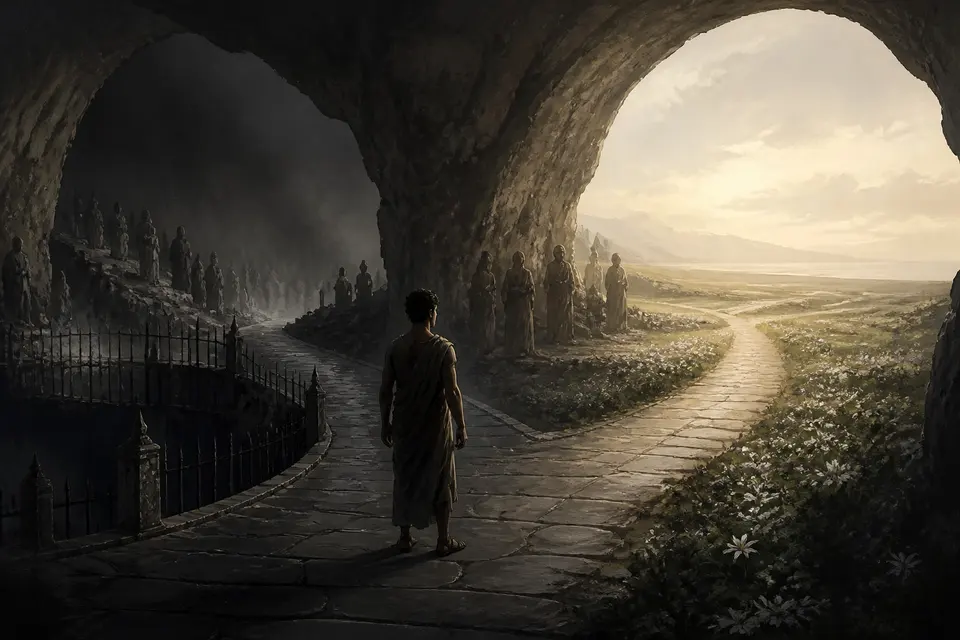
The three-judge scheme appears in Plato's Gorgias (523-524). Socrates tells a myth in which judges once were living men judging the living, and so judged badly. Zeus then appointed three of his sons. Rhadamanthus judges those from Asia, Aeacus those from Europe, and Minos decides when the other two cannot. They sit at a meadow where the road divides, one way to the Isles of the Blest and the other to Tartarus, "the dungeon of requital and penance" (Lamb's Loeb translation). The dating of the three-judge scheme is debated.
This is one author's myth, not Greek orthodoxy. In Plato's Myth of Er (Republic 10), judges send souls up or down through openings in the earth and sky. Edmonds says the traditional underworld-journey tale "is neither simple nor single."
When did they become one map?
In Virgil. In Aeneid 6, the road forks beneath the walls of Dis. The right branch leads to Elysium and the left to Tartarus (6.540-543). Rhadamanthus now rules Tartarus and forces confessions, and Virgil's Tartarus reaches down twice as far as the sky is high. After a thousand years, purified souls are called to drink from Lethe (6.743-751). Aeneas walks through all of it.
This is a Roman poet's underworld, written centuries after Homer. The move of Elysium from the ends of the earth into the underworld is post-Homeric, and its exact chronology is debated. Later writers sometimes treated the Isles of the Blessed and the Elysium inside the underworld (as in Virgil, with its Lethe) as related but distinct pictures of the blessed afterlife, and modern scholars sometimes describe them as separate or higher and lower Elysiums.
| Homer | Hesiod | Virgil | |
|---|---|---|---|
| Hades | House of all the dead | Realm of the dead | Underworld, with two roads |
| Tartarus | Pit far below Hades | Prison of the Titans | Pit for the wicked |
| Elysium | Plain at earth's end, for Menelaus | Isles of the Blessed, for heroes | Part of the underworld |
What we rely on
Ancient sources
- Homer, Iliad 8 and 15, and Odyssey 4, 11 and 24.
- Hesiod, Theogony (the Titans, the anvil and Tartarus) and Works and Days 167-173 (the Isles of the Blessed).
- Pindar, Olympian 2; Plato, Gorgias 523-524 (quoted in W. R. M. Lamb's Loeb translation); Plato, Republic 10 (Myth of Er).
- Virgil, Aeneid 6, translated by H. R. Fairclough (text via Theoi).
Modern scholarship
- Radcliffe G. Edmonds III, Myths of the Underworld Journey: Plato, Aristophanes, and the "Orphic" Gold Tablets (Cambridge University Press, 2004).