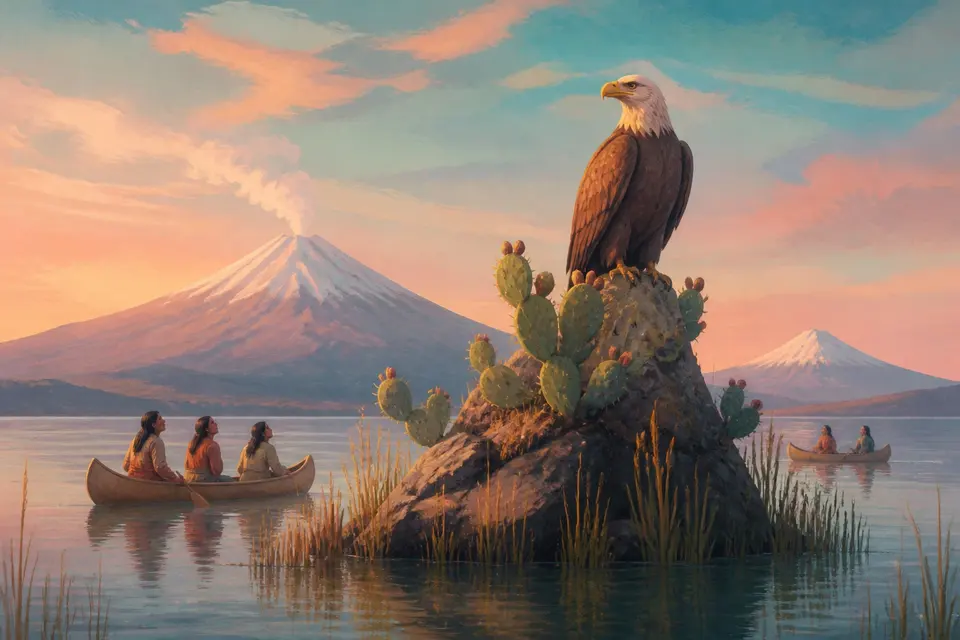
According to Mexica tradition, their god Huitzilopochtli told the people who had left Aztlán to found a city where they saw an eagle on a prickly pear cactus. They found it on an island in the lake and built Tenochtitlan, traditionally in 1325. The sources disagree on the details, including whether there was any snake.
Around 1541 or 1542, about twenty years after Spanish forces took the city, a team of Nahua painters filled the second page of a manuscript we now call the Codex Mendoza. At the center is a cactus growing out of a stone, and on the cactus stands an eagle. There is no snake in its beak. Beside it sits Tenoch, a leader whose name glyph includes a prickly pear. Around the scene runs a calendar band counting the 51 years of his reign, and below it are two cities the Mexica conquered, with a shield and arrows.
This is the founding of Tenochtitlan as one of its own people drew it. It looks different from the emblem on the Mexican flag, and that difference is the real story. This guide follows the legend, the sources that tell it, and the long road from a painted page to a national symbol.
Every written account we have was made after the conquest of 1521, by Nahua authors and Spanish friars working in the new colonial world. No codex showing the founding survives from before 1521. For how that can bend the record, see Did Montezuma Think Cortés Was a God? Probably Not.
Aztlán: the home no one can find
The story starts with a journey. The Mexica say they came from a place called Aztlán, which gave the Aztecs their modern name. Nobody has located it. Scholars also dispute whether it ever existed. The Instituto Nacional de Antropología e Historia (INAH) notes that some researchers think it was a mythical place used to give the past legitimacy.
The sources do not agree on the starting point either. Some documents give Chicomoztoc, "Seven Caves," as the origin instead. The historian Michael E. Smith counted no fewer than seventeen ethnic groups that the chronicles say migrated from Aztlán or Chicomoztoc, so the Mexica were not the only people with such a story. A historian at UNAM argues that the Aztlán narrative was devised under the ruler Itzcoatl and reworked by later rulers. That is an interpretation, but it fits what a young imperial power might want: a long march, a divine command, and a destiny.
The Codex Aubin, a Mexica annals account, begins the journey with the departure from Aztlán in the year 1 Flint, which a gloss reads as 1168. Along the way the people carry their god. Huitzilopochtli guides them and, in the accounts that INAH summarizes, is associated with the eagle. For the god himself, see The Aztec Gods.
The sign: what each source says
Here the brief version we all know breaks down. The modern legend, an eagle on a cactus eating a snake, is a composition. The old sources give several different pictures, and some give no prey at all.
| Source | What it shows or says |
|---|---|
| Codex Mendoza, fol. 2r (c. 1541-42) | An eagle on a nopal growing from a stone. No snake, no bird. |
| Teocalli of the Sacred War (carved after 1325) | An eagle on a nopal, with the burning-water war glyph at its beak. |
| Codex Aubin (1576) | An eagle with open wings devouring a serpent, on a nopal growing from a rock. |
| Durán, Historia (completed 1581) | The text has an eagle on a tunal and a bird with precious feathers in its claws. His atlas of plates shows both birds and a serpent. |
| Tovar Manuscript | The eagle devours a green bird. |
| Ramírez Codex (image) | The eagle holds a bird in one claw. |
| Crónica Mexicáyotl (c. 1609) | A list of signs at the place, and a speech in which the eagle tears and eats a serpent. |
The Codex Mendoza is the page described above. Its glyph for the city is a prickly pear growing from a stone, which we come back to below.
The Teocalli is the only surviving pre-Hispanic sculpture of the scene, and the Tribunal Electoral's volume 700 años de la fundación de Tenochtitlan treats it as the oldest depiction. Its nopal grows not from a plain rock but from a prostrate figure, identified by various scholars as Tlaltecuhtli, Cópil or Chalchiuhtlicue, since the relief is worn. At the eagle's beak is the atl-tlachinolli, "burning water," the glyph for war. It records the date 2 House, which is 1325, but it was carved later. Scholars debate how much later it was carved, and sources disagree about where and when it was found.
The Codex Aubin is the first source known to draw the founding eagle eating a serpent. Mexicolore attributes that claim to the scholar Andrew Laird. Mexicolore adds that none of the surviving pre-Conquest images of the founding scene include a snake.
Durán, a Dominican friar, wrote that the eagle stood with its wings spread to the sun. His atlas plates vary. At least one shows an eagle with a serpent, and others show the eagle with birds. Plate and folio numbers for Durán and Aubin conflict across modern sources.
The Crónica Mexicáyotl is the odd one. It mentions a serpent twice. It appears in the list of signs at the place ("donde es desgarrada la serpiente"). It also appears in a speech where the eagle is said to tear and eat a serpent. It is not drawn in a beak, because the Mexicáyotl is a text, not an image. The Spanish translator Adrián León renders the list as "donde come el águila y es desgarrada la serpiente, donde nada el pez." Its authorship is debated. UNAM calls Hernando de Alvarado Tezozómoc the principal author, while other accounts add a co-writer, Alonso Franco. The Spanish form of his first name also varies, Fernando in many books and Hernando in the Nahuatl preface.
So "no ancient source mentions a serpent" is false, and so is "every source shows an eagle eating a serpent." What can be said is that no pre-Conquest image of the scene has one. Popular articles also blame a mistranslation of the Mexicáyotl, or say the Spaniards turned the war glyph into a snake. No evidence supports either claim.
Cópil's heart
Durán also supplies the most vivid backstory. In his telling, Huitzilopochtli speaks to a leader named Cuauhtlequetzqui. The leader is sent to the stone where the heart of Cópil, son of Malinalxochitl, had fallen, and from the heart a tunal was born. The eagle stands on that cactus. The cactus, then, grows from a sacrificed enemy. This detail comes from the Durán tradition, and popular retellings repeat it freely.
A god's choice, or a landlord's permission
Mythic sign aside, history gives a more practical account. The Mexica settled the lake islets as tributaries of the ruler of Azcapotzalco, who was also named Tezozómoc (not to be confused with the later chronicler who shares his name). The Tribunal Electoral volume concludes that this undercuts the story of a site simply chosen by a god, because the ruler of Azcapotzalco had to permit the settlement. That is an interpretation, but the tribute relationship itself is well supported. Like the founders in Aeneas: The Refugee Who Founded Rome or Romulus and Remus, the Mexica turned a hard beginning into a story with a divine sign.
The date 1325
"Founded in 1325" appears on plaques and in textbooks. It is the traditional date, and the most common one in the sixteenth-century sources, which mostly agree on the year-name 2 House (2 Calli). María Castañeda de la Paz of UNAM notes that most of those records date from the second half of the sixteenth century. INAH's Templo Mayor page says the date has been debated, though most scholars accept 2 Calli as 1325. The Mendoza opens its calendar frame at that year.
The exact day is a different matter. Some press reports and official sources attribute 13 March 1325 to the Crónica Mexicáyotl, but the chronicle clearly gives only the year 2 Calli. Other sixteenth-century sources record various dates, so no day can be stated.
Other dates exist. Some researchers prefer 1345, a minority view. The historian Eduardo Matos Moctezuma has called the year 1321, sometimes used to line up 1321, 1521 and 1821, a manipulation. The scholar Patrick Johansson K. argues that 2 Calli corresponds to the appearance of the tunal without the eagle, and that the eagle's descent, which he sees as the real founding moment, came later. UNAM Ciencia notes that the Mexica may have lived on the site earlier, with the official ceremony held in that year. An astronomy preprint, not peer reviewed, suggests the date falls in the second year of a 52-year cycle and may be a chroniclers' construction. For that cycle in a related system, see The Maya Calendar and the 2012 "End of the World".
A modern hypothesis ties the founding to a solar eclipse in 1325. Jesús Galindo Trejo proposed it, and Matos Moctezuma has repeated it. But specialists note that no known document links the founding to an eclipse. The eclipse is dated by modern calculation to 13 April 1325 in the Julian calendar, which is 21 April in the Gregorian. One article in Arqueología Mexicana points out the problem for the legend: an eclipse is the sun being eaten, which sits badly with a solar eagle. Treat it as speculation. The solar side of the eagle belongs to a wider Mexica picture of the sun, told in Why Did the Aztecs Believe in Five Suns?.
What the name means
The usual explanation is that Tenochtitlan joins tetl (stone), nōchtli (prickly pear) and -tlan (place): "place of the nopal rock." That matches the Mendoza glyph, a prickly pear growing from a stone, which suggests tetl and nōchtli. The -tlan "place" element is not clearly drawn there.
But the etymology is not secure. Lexicographers have noted that the element tenoch- is disputed. One reading is "at the place near the rock-cactus-fruit," another says its nature is not entirely clear, and a third points out that the vowel length of nōch- contrasts. A later attestation suggests the vowel was short. The alternative is that the city is named after the leader Tenoch. Scholars disagree on whether he was a historical person or a mythological figure. The Mendoza shows him beside the eagle, with a prickly pear in his name glyph. The name itself may carry the story, or the story may have grown around the name.
How the eagle reached the flag
The common claim is that the nineteenth century created the emblem. That is not right. According to a summary of research by Guillermo Correa Lonche of INAH, no pre-Hispanic or colonial document shows the whole scene as we know it, but the title page of Henrico Martínez's Reportorio de los tiempos (1606) already combined the eagle, the nopal and the serpent. Later colonial publications such as the Gaceta de México, first issued in 1722, also used similar eagle imagery. The nineteenth century standardized and made official an image that already existed. It did not invent it.
The official versions changed several times. In 1815 the Congress of Puruarán set an eagle with a snake in its beak on a nopal in a lagoon. On 2 November 1821 Iturbide's decree called for a crowned eagle on a nopal, and sources conflict on whether a serpent remained. In April 1823 (the decree is generally dated 14 April) the Constituent Congress decreed the eagle on its left foot on a nopal growing from a rock among lagoon waters, gripping a serpent in its right talon, with laurel and oak branches. Many variants circulated after that, and the Second Empire changed the design again under Maximilian.
For how the Mexica imagined the dead, whose world sits behind many Mexican images, see Day of the Dead and the Aztec Land of the Dead.
Quick answers
- What kind of eagle is it? The species is unsettled, so "golden eagle" should not be treated as established.
- Is the snake Quetzalcoatl? No source we know of backs this. The eagle's link to Huitzilopochtli is attested, but reading the snake as Quetzalcoatl is a popular modern claim.
- Did the Templo Mayor excavations prove the legend? No. Matos Moctezuma's 1978 dig recovered the Templo Mayor and its offerings, but that does not confirm the eagle story or the date.
- When was the Codex Mendoza found? It has been in the Bodleian Library since 1659. Its reintroduction to scholars is usually credited to Lord Kingsborough, who published it in the 1830s.
What we rely on
Ancient sources
- Codex Mendoza, fol. 2r (c. 1541-42). Commentary: Frances F. Berdan and Patricia Rieff Anawalt, The Essential Codex Mendoza (University of California Press, 1997).
- Diego Durán, History of the Indies of New Spain, translated by Doris Heyden (University of Oklahoma Press, 1994). Also Book of the Gods and Rites and the Ancient Calendar, translated by Fernando Horcasitas and Doris Heyden (University of Oklahoma Press, 1971).
- Hernando de Alvarado Tezozómoc, Crónica mexicáyotl, translated by Adrián León (UNAM, Instituto de Investigaciones Históricas, 3rd ed., 1998).
- Codex Aubin ("Códice de 1576"), published as Historia de la nación mexicana, edited by Charles E. Dibble (1963).
Modern scholarship
- Eduardo Matos Moctezuma, The Great Temple of the Aztecs: Treasures of Tenochtitlan, translated by Doris Heyden (Thames & Hudson, 1988).
- David Carrasco with Scott Sessions, Daily Life of the Aztecs: People of the Sun and Earth (Greenwood Press, 1998; 2nd ed. 2011).
- Patrick Johansson K., "La fundación de México-Tenochtitlan. Consideraciones 'crono-lógicas'," Arqueología Mexicana 135, pp. 70-77.
- Michael E. Smith, "The Aztlan Migrations of the Nahuatl Chronicles: Myth or History?" Ethnohistory 31(3), 1984, pp. 153-186.
- José Rubén Romero Galván, "La Crónica mexicáyotl," in Los privilegios perdidos: Hernando Alvarado Tezozómoc, su tiempo, su nobleza y su Crónica mexicana (UNAM, 2003), pp. 143-152.
- Tribunal Electoral del Poder Judicial de la Federación, 700 años de la fundación de Tenochtitlan; INAH, "La piedra, el nopal, el águila y la serpiente"; Mexicolore, "The eagle and the snake" (citing Andrew Laird).