The main gods of the Mexica, the people usually called Aztecs, were Huitzilopochtli (sun and war, patron of Tenochtitlan), Tezcatlipoca ("Smoking Mirror"), Quetzalcoatl (the feathered serpent), Tlaloc (rain), Coatlicue (mother of Huitzilopochtli) and Mictlantecuhtli (lord of Mictlān). Every written source about them was produced after the Spanish conquest.
In 1978 a large carved stone disk came out of the ground in the center of Mexico City. It shows a woman who has been cut to pieces: head severed, arms and legs apart. She is Coyolxauhqui, a figure from a myth the Mexica told about the birth of their patron god, and the discovery led to the excavation of the Templo Mayor, the great temple of Tenochtitlan. The disk lay at the foot of the temple stairs. The myth explains why: the shrine was built as a model of the mountain where, according to the story, the god was born and his sister was killed.
That is the first thing to know about these gods. They are known from books written under Spanish eyes and from objects dug out of the ground, and the two do not always agree.
Seven gods at a glance
| God | Known for | Main source |
|---|---|---|
| Huitzilopochtli | War and the sun; patron of Tenochtitlan, with a shrine on the Templo Mayor | Florentine Codex Book 3, ch. 1; archaeology |
| Tezcatlipoca | "Smoking Mirror," named for the obsidian mirrors of diviners; lord of fate | Florentine Codex Book 1; Olivier's study |
| Quetzalcoatl | The feathered serpent; has Maya counterparts | Florentine Codex Book 1 |
| Tlaloc | Rain; shared the Templo Mayor with Huitzilopochtli | Florentine Codex Book 1 |
| Coatlicue | Mother of Huitzilopochtli and of Coyolxauhqui | Florentine Codex Book 3, ch. 1 |
| Coyolxauhqui | The sister killed at Coatepec | Florentine Codex Book 3, ch. 1; the 1978 disk |
| Mictlantecuhtli | Lord of Mictlān, the place of the dead; his consort Mictecacihuatl is a minor figure | Florentine Codex Book 3, Appendix |
Mexica, Nahua, Aztec: whose gods are these?
"Aztec" is a convenient word, not the people's own name. Aztecah meant "people from Aztlan" and turns up in Mexica migration accounts. Its use for the whole culture is modern, popularized by the historian Clavijero in 1780 and spread by Humboldt in 1810.
The Mexica were the rulers of the Triple Alliance, and they spoke Nahuatl. They belong to a larger family, the Nahua, who share the language and much of the culture. The Mexica themselves split into two cities, Tenochtitlan (its people the Tenochca) and Tlatelolco (the Tlatelolca). So when this article says "the Mexica," it means the dominant group, the one our sources describe best. Nahua neighbors had their own local gods and their own versions of the stories, and the sources do not give us a single tidy canon.
The Maya are a different civilization with their own language and their own gods. Some figures look related, and we will meet one below, but a Mexica god is not a Maya god with a Nahuatl name. For the founding of the capital itself, see The Founding of Tenochtitlan.
Huitzilopochtli: war, sun and a city
Huitzilopochtli was the patron of the Mexica and of Tenochtitlan. The Library of Congress, describing the Florentine Codex, calls him god of war and of the sun. His shrine stood on the Templo Mayor, and the temple had two sides: one for him and one for Tlaloc, the rain god.
Why was he tied to the sun? Scholars summarize the Mexica belief this way: Huitzilopochtli kept the sun moving across the sky, and he needed the force of human blood to do it. That belief is the reason sacrifice sits at the center of Mexica religion, and we return to it below.
Tezcatlipoca and Quetzalcoatl
Tezcatlipoca means "Smoking Mirror." The name refers to the obsidian mirrors priests used in divination. In his monograph on the god, Guilhem Olivier concludes that he is a master of fate who foretells the end of eras. He has solar, lunar and Venus connections; in Olivier's reading the night or setting sun and the moon are both important, and the sources do not neatly settle which dominates. The short gloss "smoking mirror" is accurate, but it hides a god who is hard to pin down.
Quetzalcoatl, the feathered serpent, is the best known of the group and the most tangled in later legend. The Maya had comparable figures: Kukulkan among the Yucatec Maya and Q'uq'umatz among the K'iche'. These are counterparts, not the same god, and each people told its own stories about its own figure. For a Maya story that runs on a different logic, read The Hero Twins and the Lords of Xibalba.
One famous story attached to Quetzalcoatl is a modern myth about the conquest. The idea that Moctezuma took Cortés for the returning god is not well supported. Matthew Restall and Camilla Townsend both note that teotl did not map neatly onto the European word "god"; it could also carry senses such as a powerful or sacred being, or a deity impersonator. Townsend traces the story of Cortés as a returning god to López de Gómara in 1552, and argues that Sahagún's Nahua collaborators then helped build it into a detailed, compelling narrative. The full case is in Did Montezuma Think Cortés Was a God? Probably Not.
Coatlicue and the birth at Coatepec
The best documented Mexica myth is the birth of Huitzilopochtli, told in the first chapter of Book 3 of the Florentine Codex. Coatlicue lived at Coatepec, on the way to Tula. She was the mother of the four hundred gods of the south and of their sister Coyolxauhqui. Huitzilopochtli was born fully armed. He struck Coyolxauhqui with the fire serpent and cut off her head.
The Templo Mayor was built to echo that scene, with the carved body of the dismembered sister at the foot of the pyramid. Scholars connect the disk with the sacrificial victims who were hurled down the stairs onto it. The myth gives the ritual its setting.
The great statue found in 1790 is traditionally identified as Coatlicue. That identification rests on the Florentine passage, where she appears as the mother of the patron god. A 2008 article by Cecelia Klein proposes a different reading, in which the statue shows a sacrificed creator goddess.
The dead and Mictlān
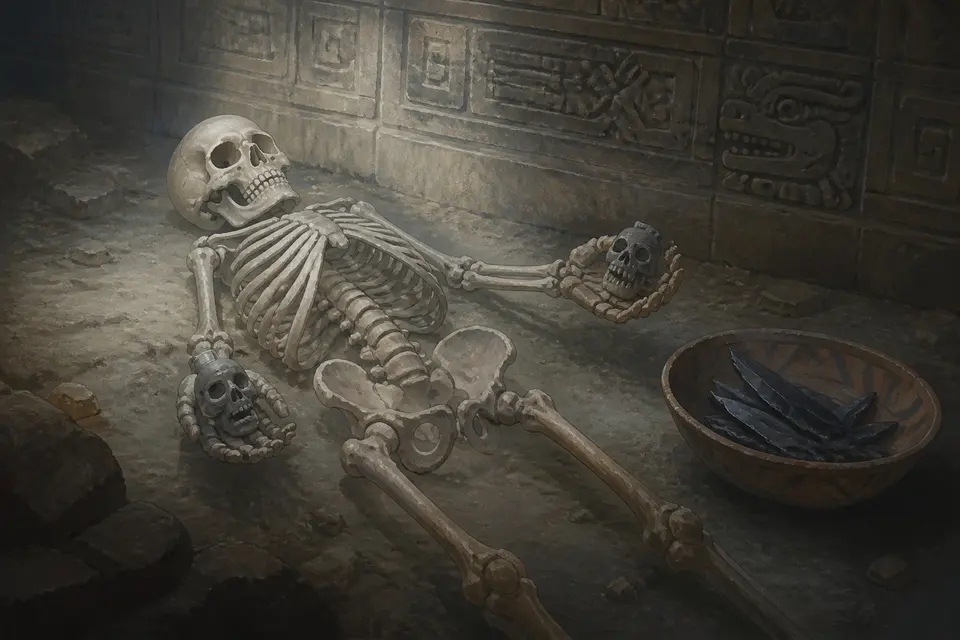
Mictlantecuhtli ruled Mictlān. According to Book 3 of the Florentine Codex (Appendix), the dead made a journey that took four years and crossed nine rivers, with the help of a dog cremated with them. The Nahuatl text says only that in the nine places of Mictlān there was "ultimate disappearance." It does not describe a hell.
The friars worked hard to turn Mictlān into a Christian place of fire and torment, so later descriptions of an "Aztec hell" deserve suspicion. The route also depended on how a person died: Mictlān was one of three possible destinations, not the only one.
The dogs need a caveat. The codex says that dogs carried the dead across the river, and the sources distinguish them by color, with reddish ones preferred. Modern tradition names the xoloitzcuintli as the guide. The old sources speak of dogs in general. The story is told in Xolotl and the Xoloitzcuintli, and the living holiday in Day of the Dead and the Aztec Land of the Dead.
The Five Suns
The Mexica told of successive suns, each destroyed before the present one. One scholar calls the Leyenda de los Soles, part of the Codex Chimalpopoca and dated 1558 in its preamble (with a closing note that points to about 1561), the best extant Nahuatl source for the destruction of the suns, ahead of the Florentine Codex. The only other Nahuatl account is the shorter version in the Anales de Cuauhtitlan (1570). The sources do not agree on the order of the suns. The text reads as if its author were pointing at painted figures, as John Bierhorst observes. Those pictorial sources are not preserved, and the Codex Chimalpopoca manuscript itself is now lost, so we depend on a 1945 facsimile. Any tidy list of the suns is a simplification; read Why Did the Aztecs Believe in Five Suns? for the details.
Human sacrifice
Human sacrifice happened. Archaeology confirms it. In 2015 excavators began uncovering the Huei Tzompantli, a rack for skulls, on República de Guatemala Street in Mexico City, beside the Templo Mayor precinct near the shrine of Huitzilopochtli. INAH identifies two building phases, about 1486-1502 and 1502-1521, and the skulls include those of women and children.
The scale is disputed. Diego Durán reports 80,400 victims at the rededication of the temple in 1487. Michel Graulich holds that nothing allows us to doubt about 80,000. Others call the figure impossible and think it served propaganda, by the Mexica or by the Spanish. A Mexicolore piece notes that a "war of contradictory figures" began in the sixteenth century, and some numbers are still quoted without question. Neither exaggeration nor denial is honest here.
What passed through a Spanish filter
Almost all our detail comes from friars, so it helps to know how each source was made.
The Florentine Codex, dated 1577, is a work in twelve books made by Nahua men under the guidance of Bernardino de Sahagún, who was commissioned in 1575 to produce a bilingual, illustrated copy. It has two columns, Nahuatl on the right and Sahagún's Spanish on the left. The Spanish is not always a literal translation. In Book 1 and its appendix, Sahagún adds his own comments, deploring idolatry and insisting that what the natives took for gods were only human beings. Roman deities appear in the Spanish columns but not in the Nahuatl. The codex is neither "a Spanish book" nor a pure Aztec voice. Scholars such as Matthew Restall describe it as a Tlatelolca-Franciscan account, produced with a team of Nahua scholars, scribes and artists from the Tlatelolco college under Sahagún's direction.
Durán, a Dominican, finished his Historia in about 1581; his books on the gods and rites and on the calendar date to roughly the mid-to-late 1570s (c. 1574-1579, depending on the source). He believed the native peoples descended from the ten tribes of Israel and that Topiltzin Quetzalcoatl was Saint Thomas. That shows how much his Spanish frame shaped what he recorded.
The Codex Borbonicus is early colonial, probably copied from a pre-Hispanic model, with glosses written for a European audience. Datings range from about 1507 to 1540, so it cannot simply be called pre-Hispanic. The Codex Mendoza (about 1541) was commissioned by Viceroy Antonio de Mendoza and is mostly about conquests, tribute and daily life, not the gods. Other ritual manuscripts do survive from before the conquest, such as the Borgia and the Cospi, but they are not Mexica books.
The situation resembles the Norse one, where books written after conversion carry the old stories; see The Norse Gods: Who Is Who in Asgard and Beyond. Archaeology is the independent check, and it supports the center of the picture: the Templo Mayor and the Coyolxauhqui disk are real.
What remains today
The Mexica gods survive in Mexican culture as names, images and debate. Coyolxauhqui and the Templo Mayor are part of Mexico City's center. The Day of the Dead may have pre-Hispanic roots, may be a European tradition reshaped in Mexico, or may be a mixture; scholars disagree. Mictecacihuatl, the relatively minor consort of Mictlantecuhtli, is often linked in popular talk to the elegant skeleton known as La Catrina, but the link is false.
Chocolate shows the shared world. The word is Nahuatl, and the common explanation "bitter water" is not settled. The Maya called the plant kakaw. The Mexica could not grow cacao in their highland homeland, so they got it by trade and tribute and used the beans as money. See Chocolate Was a Gift of the Gods (Literally). For the Maya count of days, which is sometimes confused with the Mexica, see The Maya Calendar and the 2012 "End of the World".
Quick answers
- Is Ometeotl the supreme Aztec god? Miguel León-Portilla argued for a dual creator god, Ometeotl. Richard Haly (1992) disputes it and reads the names from "bone," not "two." Ometeotl remains a hypothesis, not a fact.
- Is La Catrina Mictecacihuatl? No. La Catrina is a figure of the early twentieth century and is unrelated to the Mexica goddess.
- Is the Coatlicue statue certainly Coatlicue? No. The label is traditional, and Klein's 2008 article argues for a different identity.
What we rely on
Ancient sources
- Bernardino de Sahagún, Florentine Codex: General History of the Things of New Spain (1577), Books 1 (the gods), 3 (the origin of the gods, and the Appendix on the dead). Translation: Arthur J. O. Anderson and Charles E. Dibble (School of American Research and University of Utah, 1950-1982). Manuscript: Biblioteca Medicea Laurenziana, Med. Palat. 218-220.
- Diego Durán, Historia de las Indias de Nueva España e islas de la Tierra Firme (about 1581), and Book of the Gods and Rites and The Ancient Calendar, translated by Fernando Horcasitas and Doris Heyden (1971).
- Leyenda de los Soles, in the Codex Chimalpopoca. Translation: John Bierhorst, History and Mythology of the Aztecs: The Codex Chimalpopoca (University of Arizona Press, 1992).
- Codex Mendoza (about 1541), Bodleian Library, MS Arch. Selden A.1, and Codex Borbonicus (early colonial).
Modern scholarship
- Guilhem Olivier, Mockeries and Metamorphoses of an Aztec God: Tezcatlipoca, "Lord of the Smoking Mirror", translated by Michel Besson (University Press of Colorado, 2003).
- Michel Graulich, Mythes et rituels du Mexique ancien préhispanique (Académie royale de Belgique, 1987) and Le sacrifice humain chez les Aztèques (Fayard, 2005).
- Inga Clendinnen, Aztecs: An Interpretation (Cambridge University Press, 1991). Drawn from the Florentine Codex alone; a reviewer notes that its thesis of recently invented sacrificial rites is contradicted by archaeology.
- Alfredo López Austin, Los mitos del tlacuache (Alianza Editorial Mexicana, 1990): a theory of myth across Mesoamerica, not a manual of Aztec gods.
- Miguel León-Portilla, La filosofía náhuatl estudiada en sus fuentes (1956); English: Aztec Thought and Culture (1963). James Maffie, Aztec Philosophy: Understanding a World in Motion (University Press of Colorado), offers a different reading.
- Cecelia F. Klein, "A New Interpretation of the Aztec Statue Called Coatlicue," Ethnohistory 55 (2008).
- Matthew Restall, Seven Myths of the Spanish Conquest (Oxford University Press, 2003).