Greek mythology was part of a religion, but the two are not the same thing. The myths are the traditional stories about gods and heroes. Greek religion was the worship of those gods through ritual and sacrifice, organized by the city, with no church and no creed.
What is the difference between Greek myth and Greek religion?
Britannica puts it simply: Greek religion is not the same as Greek mythology, which deals with traditional tales, though the two are closely interlinked. The stories told who the gods were, such as the family described in The Twelve Olympian Gods: Who They Are and How They Are Related. The religion was what people did for those gods: pray, pour libations, sacrifice, hold festivals.
Scholars do not treat this as a clean split between "stories" on one side and "cult" on the other. Walter Burkert, in Structure and History in Greek Mythology and Ritual, sets myth and ritual side by side and links them at a structural level. How exactly myth and ritual relate is still debated.
Did the Greeks have a word for "religion"?
No. Britannica says the nearest Greek terms were eusebeia, usually translated "piety," and threskeia, "cult." Neither names a bounded system of belief that a person could join or leave. Wikipedia adds that applying the modern concept of "religion" to ancient cultures has been questioned as anachronistic, and that no Greek writer is known to have sorted the gods and cult practices into separate "religions."
Eusebeia is generally described as concerned with performing the actions appropriate to the gods. An inner, spiritual sense of piety is a later development at most, and it is not established for the classical period.
So the answer is yes, but not in the modern sense of a church with a creed. Many scholars still use "religion" as a convenient label, and that use is debated too.
What did Greek religion actually consist of?
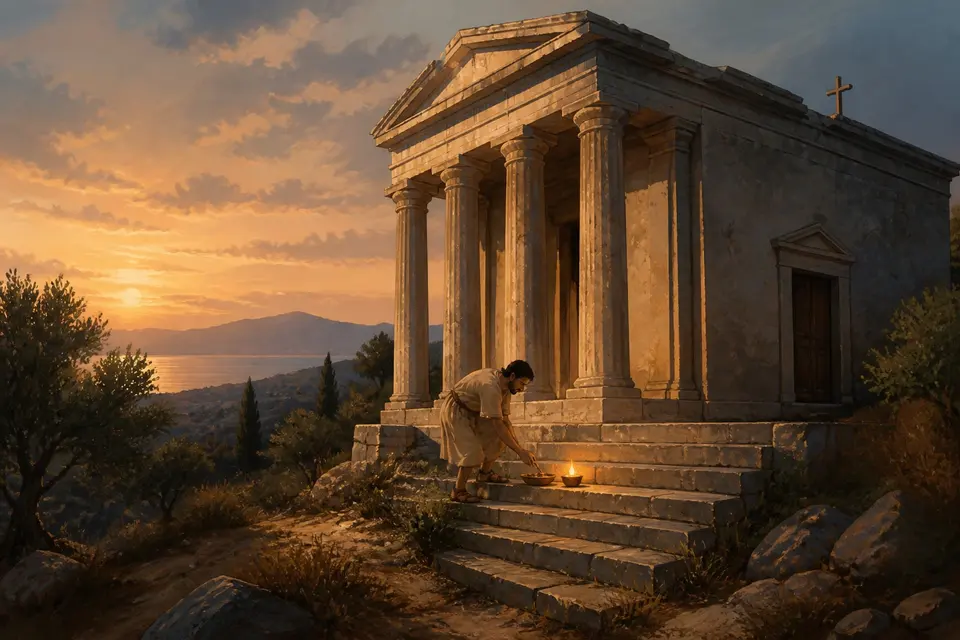
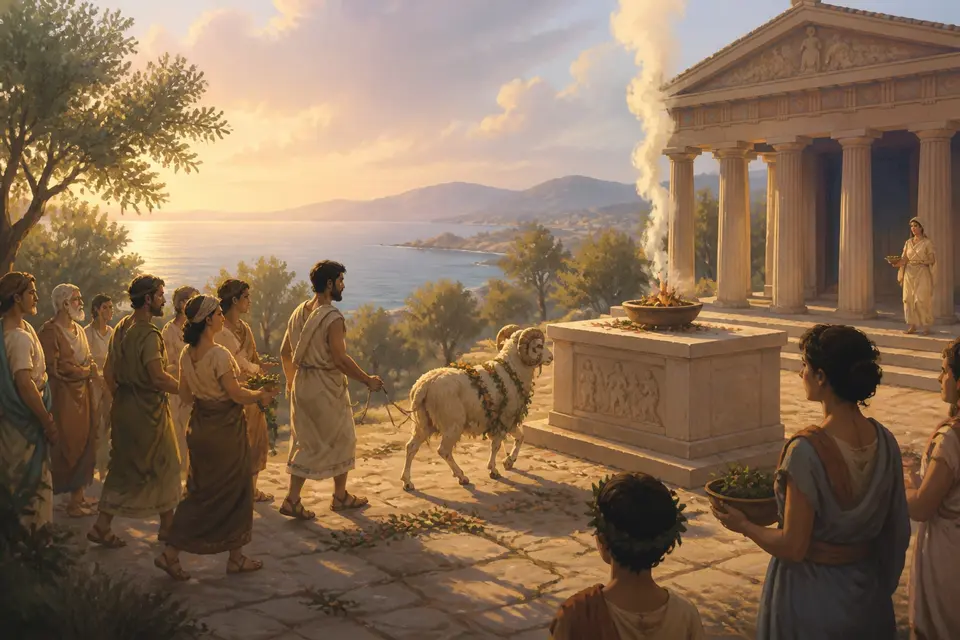
Mostly practice. Britannica describes worship through rituals and sacrifices, which were the principal proofs of piety. Burkert's standard survey, Greek Religion, covers sacrifices, libations, purification, gods, heroes, the priesthood, oracles, festivals and the afterlife.
That range is wide. A festival like the one in The Ancient Olympics Were a Festival for Zeus and a consultation at The Oracle of Delphi: Who Spoke for Apollo? both belong to this world. Britannica dates the developed religion across more than a thousand years, from the time of Homer (probably the 9th or 8th century BCE) to the emperor Julian (4th century CE). Those dates are a convention, not sharp edges.
Who ran it: priests, or the city?
The city did. Scholars quoted in a Journal of Institutional Economics article describe cult as the backbone of much civic life, closely tied to politics. The same article says the polis regulated public religious practice: festivals, sacrifices and laws against impiety.
Greek priests and priestesses existed (hiereis and hiereiai). Citing Burkert and others, that article describes them as laymen, officials of the state like magistrates, administering rites. There was no head of a church and no hierarchy. Beate Dignas notes that textbooks on Greek religion stress that a priest was a civic official whose office had nothing to do with dogma or expertise. That is a generalization, and she tests it against one city, Rhodes. So the accurate wording is "no clergy organized like a church," not "no priests."
Robert Parker took this up in his 2008 Townsend Lectures at Cornell, published as On Greek Religion. One chapter is titled "Religion Without a Church." Parker also reviews the argument over "polis religion," the idea that Greek religion was essentially civic. Hugh Bowden's review reports that Parker finds both sides have some right on their side. So even the "civic religion" picture is a thesis, not settled fact.
Did the Greeks have to believe in their gods?
Some belief was expected. Britannica says Greeks were expected to believe that the gods existed and to perform ritual and sacrifice. Denying a deity's existence risked reprisals, from the god or from other people. Impiety (asebeia) was an offence the polis could punish by law, and Socrates was famously charged with it in Athens.
Modern writers often sum this up as practice mattering more than belief. As shorthand it is useful, but it can mislead. The claim that the Greeks did not care what anyone privately thought is an overstatement. Parker's book takes up the relation between ritual and belief, notably in its opening chapter, "Why Believe without Revelation?", and he treats the question as one that needs careful handling rather than a settled one.
So was Greek mythology a religion?
The stories were not a scripture and not the whole of the religion. They were the shared tradition that gave the gods names, relationships and histories, while the religion itself was a set of acts carried out for those gods, inside the life of the city. Figures like Hades could be both a character in tales and a power approached in cult. For one example of how the stories differ from a modern idea of evil, see Hades Is Not the Devil.
Two cautions. Roman religion was its own tradition, not Greek religion under new names; see Greek and Roman Gods, Side by Side (and Why They Are Not Just Renamed). And modern Hellenism (Hellenismos) is a modern reconstruction, not ancient Greek religion itself. For why the myths keep returning today, read Why Greek Myths Are Being Retold Right Now.
What we rely on
Ancient sources
- The Homeric poems (conventionally 9th or 8th century BCE), the starting point Britannica gives for developed Greek religion.
Modern scholarship
- Walter Burkert, Greek Religion: Archaic and Classical, translated by John Raffan (Harvard University Press and Blackwell, 1985; German original, Kohlhammer, 1977): the standard survey.
- Robert Parker, On Greek Religion (Cornell University Press, 2011): the Townsend Lectures, including "Religion Without a Church."
- Beate Dignas, "Rhodian Priests after the Synoecism," Ancient Society 33 (2003), 35-51.
- Hugh Bowden, review of Parker, On Greek Religion, Journal of Hellenic Studies 132 (2012).
- Encyclopaedia Britannica, "Greek religion": an encyclopedia overview of terms, practice and dates.