The myth of Arachne is the story of a Lydian weaver who boasted that she could outweave the goddess Minerva (Athena to the Greeks). Her tapestry was flawless, the goddess destroyed it in anger, and Arachne was turned into a spider. The fullest surviving telling is Ovid's Metamorphoses 6.1-145.
Who was Arachne before the contest?
In Ovid, Arachne is not a princess or a nymph. Her father, Idmon of Colophon, dyes wool in Phocaean purple, and her mother is dead. She lives in humble Hypaepa, yet she is famous across the cities of Lydia for her skill alone. Nymphs of Mount Tmolus and the river Pactolus come to watch her work. Ovid sometimes calls her "Maeonian", since Maeonia is another name for Lydia.
Onlookers could see how much Minerva had taught her. Arachne denies it.
The tale has a frame. In Book 5 the Muses sing, and Minerva approves of the song. Praise is not enough for her, though: she decides her own divinity must not be scorned without punishment. Ovid's goddess is the Roman Minerva, also called Pallas or Tritonia in the poem. The Roman tradition is a separate one, as Greek and Roman Gods, Side by Side explains.
How does the contest begin?
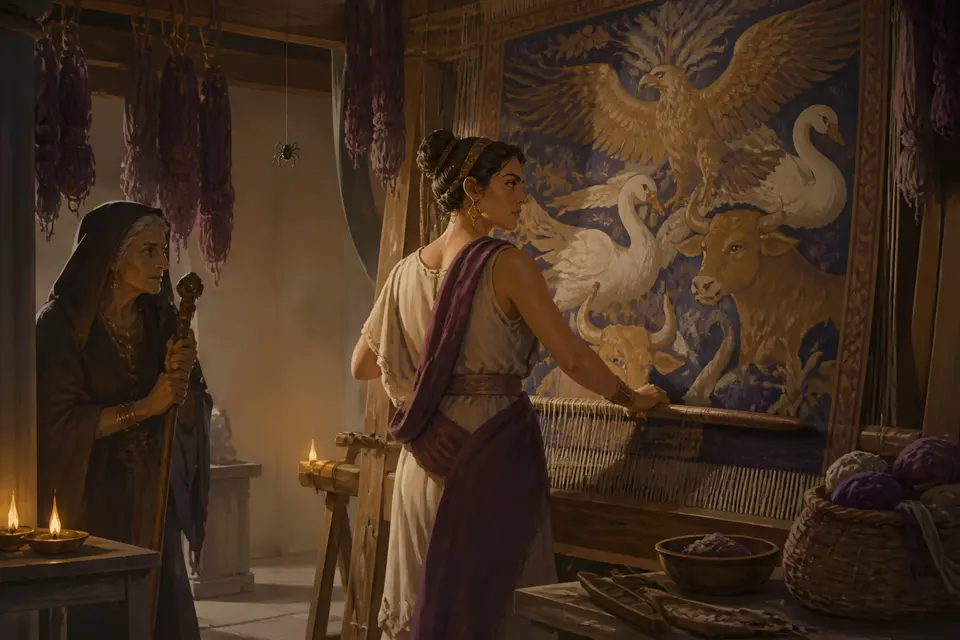
Minerva comes disguised as an old woman with a stick and advises Arachne to be humble before the gods. Arachne scorns the advice and tells the old woman to bring the goddess herself. Minerva throws off the disguise. Everyone present worships her except Arachne, who flushes, goes pale, then blushes again, and will not yield.
Both begin to weave.
What did the two tapestries show?
Minerva's centre scene is her dispute with Neptune over Athens, on the Areopagus, where she offers an olive tree against his salt spring. In the four corners she places contest scenes, among them Rhodope and Haemus, the Pygmy queen, Antigone and Cinyras. These are meant to warn Arachne what happens to mortals who challenge the gods. An olive-wreath border finishes it.
Arachne weaves the opposite: gods who deceive mortal women while in disguise. Europa and the bull, Asterie and the eagle and Leda and the swan appear, and Neptune turns up as a bull, a ram, a horse, a bird and a dolphin. A narrow border of flowers woven with ivy closes the work. Some modern commentators count about twenty-one such episodes. That tally is theirs, not Ovid's, and it is approximate.
Who won the weaving contest?
Ovid does not say. He names no judge, and later retellings that have the nymphs or Zeus judge are adding to him. He says only that neither Pallas nor Envy could find fault with Arachne's work. It is Minerva's anger at a flawless piece that settles the matter. She tears the web apart and strikes Arachne on the head with a boxwood shuttle, "thrice and again" in Miller's translation.
How does Arachne become a spider?
Arachne puts a noose around her neck. Minerva lifts her up and says, in Ovid's Latin, vive quidem, pende tamen: "Live, then, yet hang." The same fate is decreed for her descendants. The goddess sprinkles her with the juice of Hecate's herb (Ovid does not name the plant; for the goddess, see Hecate: The Goddess at the Crossroads). Arachne's hair, nose and ears fall away, her body shrinks, her fingers become legs, and she spins thread from her belly. The last line (6.145) uses the Latin word aranea, "spider", for the creature that still works at its ancient webs.
The name does the same job. Greek aráchnē simply means "spider" or "spiderweb", so her name is the common word for the animal she becomes.
What does the myth mean?
Ovid states no moral. The usual reading is a warning against hubris, and it is also an origin story for spiders and spinning. But Ovid gives Minerva's tapestry the plainly didactic role, and he does not say that either tapestry or worldview triumphs. An essay in the Antigone Journal, "An Aaful Story: Ovid and the Geordie Spider", questions how provocative Arachne's tapestry really is to Minerva. The next story, Niobe's, follows directly, and Niobe, who knew Arachne, takes no warning from her fate.
Other scholars read the weaving as a comment on Ovid's own poetry, since weaving was already a metaphor for storytelling. Denis Feeney (1991), as cited in a University of New Mexico thesis, reads the contest as a choice between two poetic styles. Readings that make Ovid a sympathizer with Arachne, or that treat the tale as feminist, are modern interpretations, not his stated intent.
Is Ovid the only source?
For a full narrative, yes: nothing earlier survives. Ovid's sources for the tale are uncertain; it may draw on earlier traditions that are now lost. Some scholars suspect it reworks an older Greek tradition, but the evidence for that is indirect and disputed.
Other evidence is thin.
- Virgil, Georgics 4.246 ff. (about 29 BCE), speaks of the spider "hateful to Minerva" hanging her nets in the doorway. He names the spider, not Arachne, so it is at most an echo of the enmity.
- Pliny, Natural History 7.196, lists Arachne as the inventor of linen and nets, and her son Closter as inventor of the wool spindle. It is a list of inventors, not a story.
- A note on the poet Nicander is reported to make Arachne an Attic girl with a brother, Phalanx, whom Athena taught; they are turned into spiders. We know it only through modern summaries.
- A Corinthian vase of about 580-560 BCE has been proposed as an early picture of the contest. The identification is disputed, since it could show Athena teaching weaving in general.
For other weavers in Greek myth, see Penelope: The Weaver Who Outwitted 108 Suitors. For the goddess herself and her family, see the hub guide, The Twelve Olympian Gods: Who They Are and How They Are Related.
What we rely on
Ancient sources
- Ovid, Metamorphoses 6.1-145 (the contest and the transformation), with the framing in Book 5. Translations consulted: A. S. Kline (sections 1-145); Frank Justus Miller (Loeb).
- Virgil, Georgics 4.246 ff. Translation: H. Rushton Fairclough.
- Pliny the Elder, Natural History 7.196. Translation: H. Rackham.
Modern scholarship
- Denis Feeney (1991) on Ovid's contest as a choice between poetic styles, as cited in a University of New Mexico thesis.
- "An Aaful Story: Ovid and the Geordie Spider", Antigone Journal (2021), on how provocative Arachne's tapestry is to Minerva.