The Greek gods did not come from one place. Greek poets said they were born from Chaos and Earth. Late Bronze Age tablets show some of their names in use from the 14th century BCE or possibly earlier (the Knossos tablets are variously dated to about 1450-1375 BCE), and at Pylos in the 13th century. The name of Zeus reaches back to an Indo-European sky god. The story of how the gods took power also has older Near Eastern parallels.
What did the Greeks say about their own gods?
The fullest Greek answer is Hesiod's Theogony, composed around 700 BCE (the date is debated by about a generation). Hesiod asks the Muses which gods came first, and they answer: Chaos. Then comes wide-bosomed Gaia (Earth), then Tartarus and Eros. Night and Erebus are born from Chaos.
Uranus (Heaven) is not first. He is Gaia's first-born, whom she bears equal to herself, along with the Mountains and Pontos, the sea. From this family come the Titans and, in time, Zeus and his siblings, the group described in The Twelve Olympian Gods: Who They Are and How They Are Related.
"Chaos" does not mean a mess. Some translators render it as "chasm," and the scholar Francis Cornford read it as the separation of earth and sky. Scholars still debate its exact sense.
Did Herodotus think the gods came from Egypt?
Yes, and he is the earliest surviving Greek prose writer to discuss at length where the gods' names came from. In his Histories (2.50) he says most divine names came to Greece from Egypt, with Poseidon credited to the Libyans. At 2.52 he adds that the Pelasgians first sacrificed to unnamed gods, and that the oracle at Dodona told them to adopt names from foreign parts. At 2.53 he says Hesiod and Homer, living no more than 400 years before him, gave the Greeks the gods' descent, names, honours and forms.
That is Herodotus' theory, not an established fact. Greek divine names bear little resemblance to Egyptian ones, and modern scholars find his claim puzzling.
How old are the names? What Linear B shows
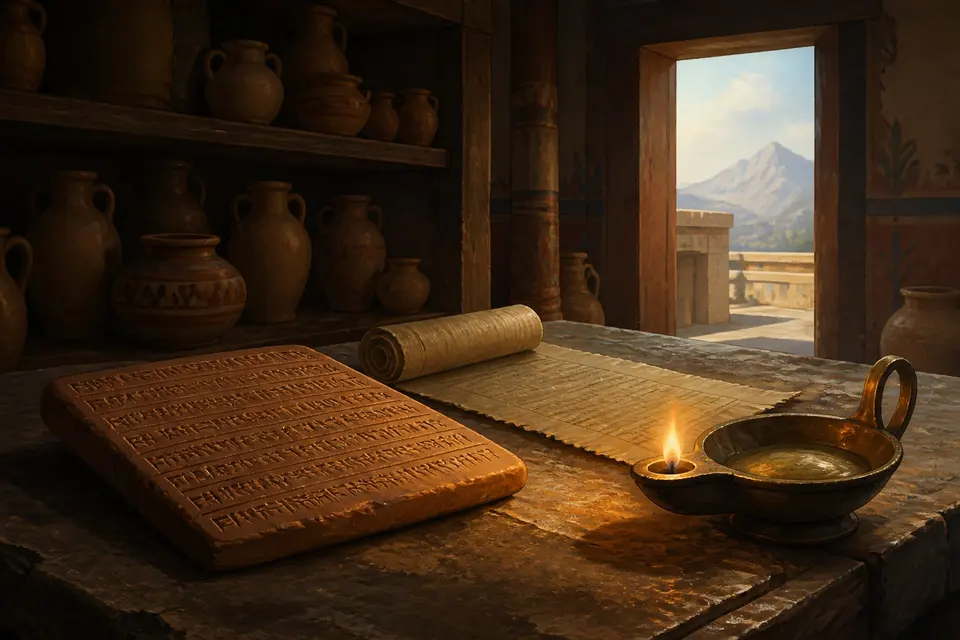
Linear B is an early script that records Greek. Michael Ventris announced its decipherment on 1 July 1952. It was used in the Late Bronze Age, roughly from the 15th-14th century (the Knossos dating is debated) until about 1200 BCE. The tablets are administrative records: lists of offerings, places of worship and the names of deities. They contain no myths and no family trees.
Even so, the names are there. Zeus appears as di-we, with sanctuaries at Pylos and Chania, and a Knossos text calls him "Dictaean." A Pylos tablet (Tn 316) records a joint cult of Zeus, Hera and a figure called Drimios, read as "son of Zeus." That reading is uncertain, and it fails if one word is a scribe's error for "priest." Poseidon appears at Knossos and Pylos. Hermes, Artemis, Ares and Dionysos are also attested, and a Chania tablet shows Zeus and Dionysos worshipped together.
Athena needs care. The only possible attestation is at Knossos, where a phrase can be read "Mistress Athena" or "the Lady of At(h)ana," perhaps Athens. Which is right is debated.
Some Mycenaean gods vanished or merged. Paiawon, who appears at Knossos, is read as the later "Paian" title of Apollo. That the tablets prove a full Olympian pantheon is an inference. They show names, not a hierarchy.
There may be Minoan or pre-Greek contributions too. A Knossos text names a "mistress of the Labyrinth," and the name Pi-pi-tu-na is possibly pre-Greek or Minoan, though its etymology is uncertain. Knossos was a Minoan site under Mycenaean rule, so the two cults are hard to separate. For the site itself, see The Minotaur and the Real Labyrinth of Knossos.
What does the Indo-European past explain?
The name Zeus continues a reconstructed Proto-Indo-European daylight-sky god, *Dyēus, also called *Dyēus ph₂tēr, "Sky Father." The same word appears in Vedic Dyáuṣ Pitṛ́ and in Latin Jupiter, a shared name, not proof that Roman religion copied Greek (see Greek and Roman Gods, Side by Side). This is M. L. West's reconstruction.
The limits matter. *Dyēus was probably not a ruler of the gods or a thunder god. Some scholars think Zeus's storm-god traits are a later development, perhaps from contact with Near Eastern traditions, but this is debated. Hera has no clear Indo-European origin, and several rival etymologies have been proposed.
What do Near Eastern stories add?
The shape of Hesiod's succession myth has older cousins. The Kingship in Heaven (the Song of Kumarbi) is a Hittite version of a Hurrian myth, written in the 14th or 13th century BCE. The gods are mostly Hurrian in name. The sequence runs Alalu, Anu, Kumarbi, Teshub. Kumarbi bites off and swallows Anu's genitals, and so becomes pregnant with several gods, including the storm-god Teshub, who is eventually born from him (the broken text leaves the details unclear).
West set this beside the Greek line Uranus, Cronus, Zeus, and the Babylonian Anu, Ea, Marduk. In each, the first is the personified Sky and the third is or has absorbed a storm-god. The Babylonian Enūma eliš fits more loosely: it pits young gods against the primordial pair Apsû and Tiāmat, while Hesiod passes conflict down the generations (see Tiamat and Marduk).
The parallels are agreed. How they travelled is not. Walter Burkert's "Orientalizing Revolution" places the influence around 750-650 BCE. Others favour a Bronze Age route through Hittite or Hurrian contact, and one recent article suggests that some correspondences may show Hesiod subverting Assyrian ideological discourse. Nobody has shown that Hesiod copied a particular text.
So where did the Greek gods come from?
From layers. Some names, Zeus above all, are very old and Indo-European. Many were already in cult by the Bronze Age, as the tablets show. The poets then gave the gods their family tree and their rise to power, borrowing story patterns from the Near East. For a Mycenaean world seen through epic, see Was the Trojan War Real?
What we rely on
Ancient sources
- Hesiod, Theogony 115-133. Translation: H. G. Evelyn-White (1914).
- Herodotus, Histories 2.50-53 (the gods' names and origins).
- Kingship in Heaven (CTH 344). Translation: Harry A. Hoffner Jr., Hittite Myths, 2nd ed. (Scholars Press, 1998).
Modern scholarship
- Michael Ventris and John Chadwick, Documents in Mycenaean Greek, 2nd ed. (Cambridge University Press, 1973).
- M. L. West, The East Face of Helicon (Clarendon Press, 1997), and Indo-European Poetry and Myth (Oxford University Press, 2007).
- Johannes Haubold, "Conflict, consensus and closure in Hesiod's Theogony and Enūma eliš," in Bassino, Canevaro and Graziosi (eds.), Conflict and Consensus in Early Greek Hexameter Poetry (Cambridge University Press, 2017), 17-38.
- "The Politics of Beginnings: Hesiod and the Assyrian Ideological Appropriation of Enuma Eliš," Archiv für Religionsgeschichte 21-22 (2020), 343-368.