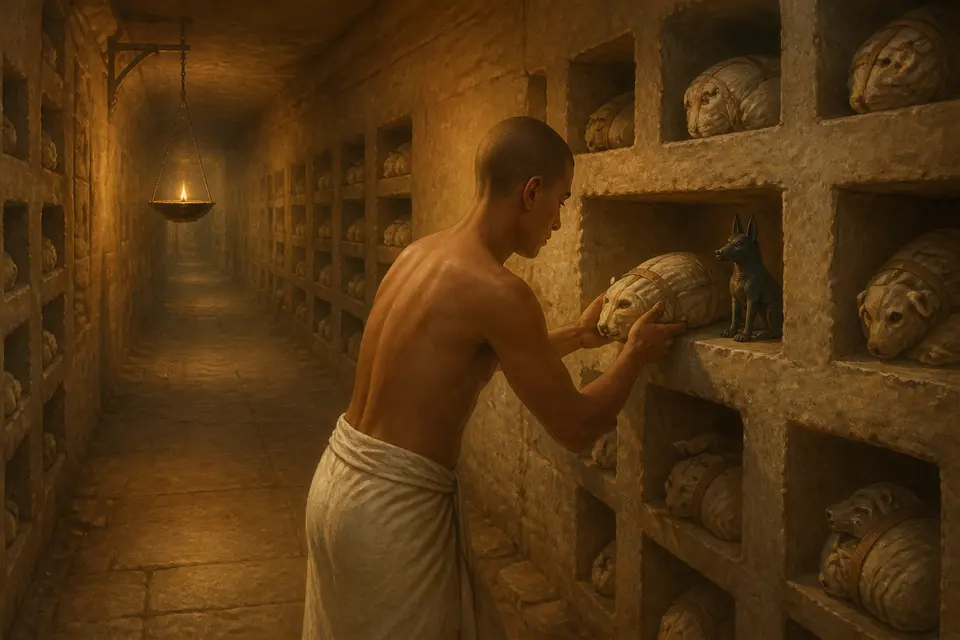
The Egyptians offered Anubis mummified animals, above all dogs, which pilgrims left in the dog catacombs at North Saqqara, a cult that peaked in the Ptolemaic Period (the catacombs are thought to have been dug in the fourth century BC). The bread, beer and oxen in tomb texts were not gifts to Anubis: he is named there as the god through whom the offering reached the dead.
What does the offering formula say about Anubis?
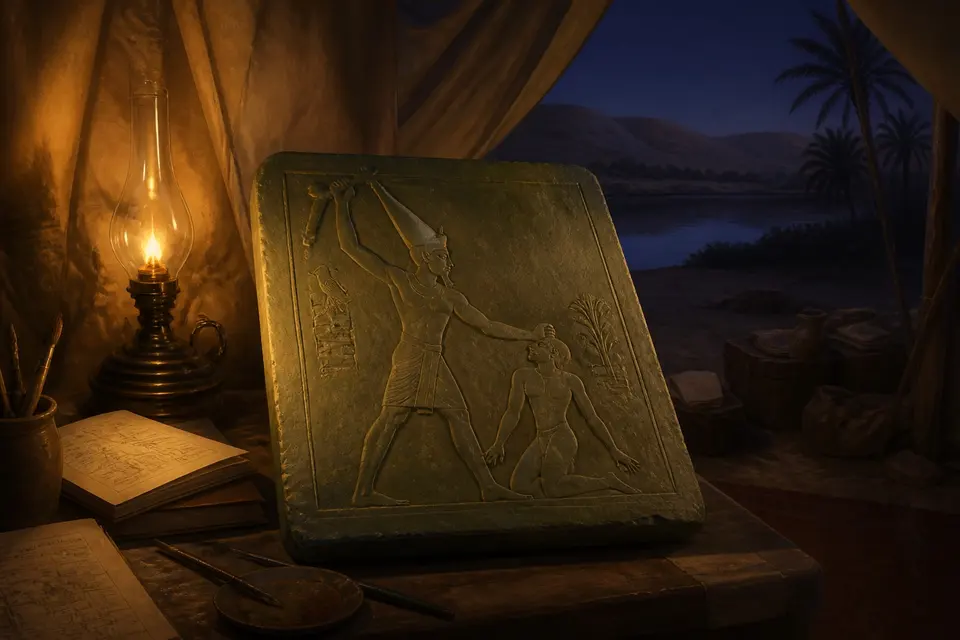
Many tomb inscriptions open with ḥtp dj nswt, "an offering given by the king." A god's name follows, then a list of offerings. The formula has four parts: the king, a god, the requests, and the recipient. The recipient is the dead person, not the god. A visitor to the tomb read the invocation aloud, the prt-ḫrw, literally "the going forth of the voice," and the god was asked to send bread, beer, oxen, fowl, alabaster and clothing to the dead person's ka. The king's name marks the offering as royally authorized, not as handed over by the king himself.
Anubis often fills the god's slot. His epithets there include "Foremost of the divine booth," "He who is on his mountain," "who is in the place of embalming" and "Lord of the sacred land," meaning the necropolis. In the Old Kingdom mastaba of Urirenptah, a priest of Ra and Hathor, a museum translation (NGV label "Pharaoh: Mastaba") has Anubis, Foremost of the Divine Booth, give an invocation-offering of bread, beer, beef and fowl on New Year's Day, at the Thoth festival and at other festivals, including every monthly and half-monthly festival.
Scholars disagree about the grammar. Alan Gardiner read the phrase as a dative: an offering which the king gives to Osiris. More recent work holds that Egyptian had no dative in the Old or Middle Kingdom, which favors "given by" the god. Either way, the list is for the dead. For the wider picture of that journey, see The Journey to the Afterlife in Egyptian Mythology.
In the earliest formulas Anubis seems to stand alone. The dates are debated: some place this in the Fourth Dynasty, with many gods, Osiris among them, appearing in the Fifth. The trend is clear: Osiris soon became popular in the formula. His story is told in Isis and Osiris: The First Murder Mystery.
Was linen offered to Anubis?
"Linen" in the standard list means clothing or textiles for the dead, not embalming cloth. There is one famous linen link, but it is about an image. Tutankhamun's Anubis shrine held a jackal statue wrapped in a linen shirt inscribed with year 7 of Akhenaten, and its inscriptions call on Imiut, "He who is in his wrappings," and Khenti-seh-netjer. That shows a statue of Anubis being dressed. It is not a recorded linen offering to the god.
What was actually given to Anubis?
Animals. At North Saqqara, archaeologists Paul Nicholson, Salima Ikram and Stephen Mills studied two canine catacombs side by side, dedicated to Anubis (published in Antiquity in 2015). More than 90 percent of the mummies are dogs, many of them very young puppies, probably bred for the cult. The catacombs are thought to have been dug in the fourth century BC and were used mainly during the Ptolemaic Period.
Press reports give about eight million animals, but that is an estimate from sampling the tunnels, so the exact count is debated. Nicholson's reading is that each mummy gave a representation of the god a fitting burial. Ikram puts it this way: "each mummy would be a symbol of something a pilgrim had given as a gift to the god." The offering was, in effect, a mummified votive.
What did Strabo see at Cynopolis?
The Greek geographer Strabo, writing in the Roman period, says that at Cynopolis "Anubis is held in honour" and that "a form of worship and sacred feeding" is arranged for dogs (Geography 17.1.40, in Philip Harland's translation). Another translation says they "worship the dog Anubis." This is an outside observer, not an Egyptian source.
Cynopolis was Hardai, in the 17th Upper Egyptian nome. Whether it was "the" center of the cult is debated, since Asyut (Lycopolis) is also named as a major seat. Do not confuse Cynopolis with Saqqara: the catacombs belong to the Memphis region. Strabo describes dogs being fed and honoured at Cynopolis, not sacrificed, so popular claims that dogs were sacrificed there are not supported by him. Plutarch's story of dogs being killed (De Iside et Osiride 72) concerns the neighbouring Oxyrhynchites in a later feud. For why a jackal, or perhaps a wolf, stands behind all this, read Why Is Anubis a Jackal? A different animal cult is covered in Bastet and the Cats of Ancient Egypt.
Did priests dress as Anubis?
Only partly documented. A clay jackal mask in Hildesheim (PM 1585) dates between the 26th and 30th Dynasty; its findspot is unknown, and the museum acquired it in 1910. Some museum texts say a funerary priest could become the god by wearing it. Glencairn Museum's 2023 essay on dogs and jackals discusses priests wearing Anubis masks and illustrates the Hildesheim mask.
A recent German study (a 2018 to 2021 project) revisits the old suggestion that the object might be a model for lighter masks. It also notes a roof relief at Dendera of a priest acting as Anubis in the late Ptolemaic or early Roman period, so the mask's use may have been in temple cult rather than only in funerary ritual. How the mask was used, and whether this happened in the Old Kingdom, is debated. It was not a general embalmer's uniform.
What about incense, rum and chocolate?
Modern lists of such gifts for Anubis appear in present-day Kemetic and pagan writing, not in ancient sources. Cypress as his plant and the number nine as his number likewise appear in modern spiritual and pagan writing, and no ancient Egyptian source for them is cited. For the god in his wider family, see The Egyptian Gods: Who Is Who.
What we rely on
Ancient sources
- Strabo, Geography 17.1.40, in Philip Harland's translation.
- The offering inscription of Urirenptah's mastaba, as translated on the National Gallery of Victoria label "Pharaoh: Mastaba."
Modern scholarship
- P. T. Nicholson, S. Ikram and S. Mills, "The Catacombs of Anubis at North Saqqara," Antiquity 89 (345), 2015.
- Hans Kayser, Die ägyptischen Altertümer im Roemer-Pelizaeus-Museum in Hildesheim (the Anubis mask).
- Glencairn Museum, "Companions and Guardians: Dogs and Jackals in Ancient Egypt," newsletter, 25 October 2023.