No Egyptian text says why the Great Sphinx was built. Most Egyptologists attribute it to King Khafre of the 4th Dynasty and infer a royal, sun-linked monument beside his pyramid complex. That purpose is a reconstruction from its setting and from later evidence, not an ancient statement.
Who built the Great Sphinx, and when?
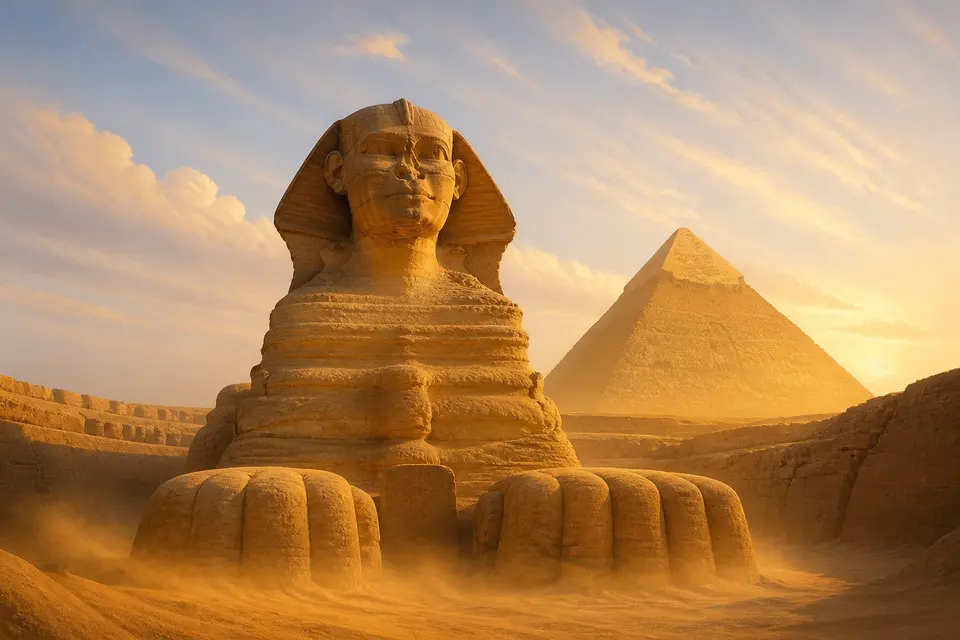
The Sphinx is a limestone lion with a human head, about 73 m long and 20 m high, lying on the Giza plateau. Most Egyptologists say it was carved under Khafre, whose reign is dated 2558-2532 BCE, by masons working on his pyramid complex.
The case is contextual. No inscription naming Khafre or any other builder has been found. Mark Lehner and Zahi Hawass argue that the Sphinx fits Khafre's plan for his pyramid and temples. Some scholars have proposed Khufu, Khafre's father, or Djedefre instead, and there is no consensus on whose face it shows.
Was it carved from a quarry?
Yes, in substance. The statue was cut from bedrock left standing in a quarry. Fossil analysis by Aigner and Lehner showed that the wall blocks of the nearby Sphinx Temple came from the Sphinx ditch. The builders carved the figure and used the stone they removed to build the temple.
What was it for?
Nobody knows for certain. No excavated Old Kingdom material mentions its construction, and where it appears in later records it seems to have always existed. We do not even know what Old Kingdom Egyptians called it.
Scholars infer a royal and solar role from its place in Khafre's complex and from later evidence. A lion body with a human head is a natural way to show royal power. Some Egyptologists in the Lehner school also read the Sphinx Temple and enclosure as never fully completed or put into regular cult use at the time.
The popular idea that it was built as a "guardian of the pyramids" is a modern framing, not a documented ancient purpose. For the sun god's wider setting, see Ra's Night Journey and the Serpent That Wanted to Stop the Sunrise.
When did Egyptians start calling it Horus of the Horizon?
By the New Kingdom, about a thousand years after Khafre, the Sphinx was revered as the sun god Hor-em-akhet, "Horus of the Horizon" (Harmachis in Greek). That is the earliest solid evidence for this identity. It does not show that Khafre's builders intended it.
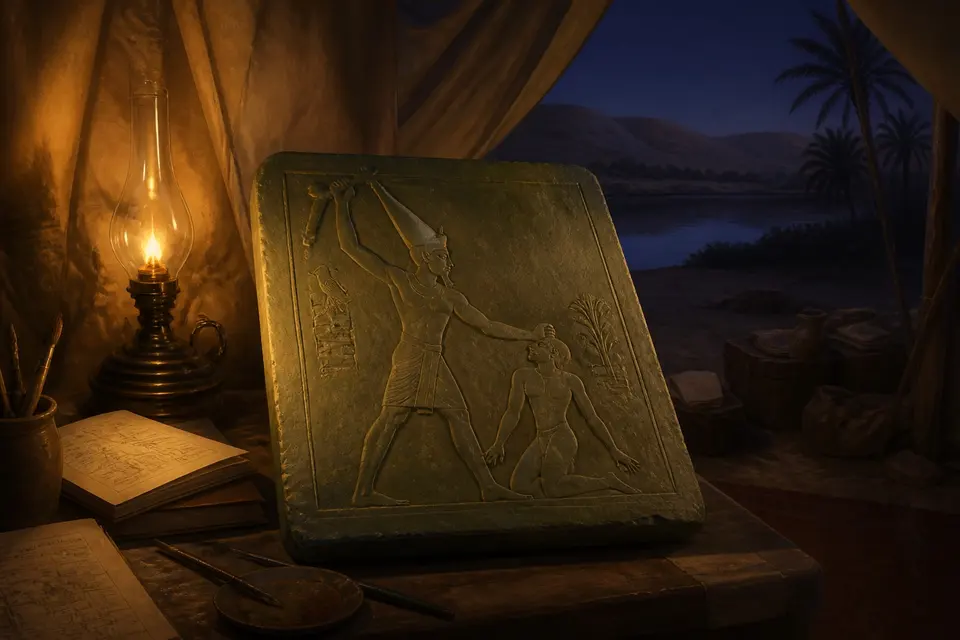
The best evidence is the Dream Stele of Thutmose IV (reigned about 1401-1391 BCE), set between the Sphinx's paws. It tells how a prince fell asleep in the Sphinx's shade and dreamed that the god promised him the kingship if he cleared away the sand. In Selim Hassan's 1953 translation the god calls himself Hor-em-akhet-Kheperi-Ra-Atum. About half the text is missing.
Some scholars read the story as propaganda to legitimise a king who was not the expected heir. That is an interpretation, and the stele says nothing about who built the Sphinx. It does show that the monument was buried in sand by then. Excavators in the early 19th century still found it buried to the chest, and it was fully cleared only in the 1930s. For the gods named here, see The Egyptian Gods: Who Is Who.
Why does the Sphinx have no nose?
Not because of Napoleon. The Danish traveller Frederic Louis Norden sketched the Sphinx without a nose in 1737, decades before Napoleon's expedition, and other earlier depictions agree.
The medieval Egyptian historian al-Maqrizi reports that a Sufi named Sa'im al-dahr destroyed the nose and ears in 1378, because peasants were making offerings to the statue in hopes of a good Nile flood and harvest. Scholars debate the attribution. Examination of the face shows a deliberate act with rods or chisels, and Lehner holds that the evidence supports an intentional break.
Is the Sphinx older than Egypt?
No. In 1991 Robert Schoch argued that water erosion on the enclosure walls points to rainfall and a date of roughly 7000-5000 BC. He later pushed his estimate back toward 10,000 BC. Critics found flaws in the method of Schoch and his collaborator John Anthony West. They also noted that the enclosure fits the Giza layout and that its limestone was used in nearby buildings. Geologists attribute the erosion to Nile flooding and occasional heavy rain that continued into the Dynastic period.
A more modest dissent exists. Colin Reader argued in 2001 that the Sphinx may predate Khufu. Even a critic like James Harrell describes that as older than Khafre by only a few hundred years. It is still a Giza, Old Kingdom date, and it gives no support to a lost civilization. For how that kind of story grows, see Atlantis: What Plato Actually Wrote.
Where does the name "Sphinx" come from?
It is Greek. Classical writers, roughly two thousand years or more after it was made, called the statue a "sphinx" by comparison with a Greek monster, a winged lion with a woman's head. The Giza figure has no wings and a king's face.
One proposed origin is the Greek verb "to squeeze" or "strangle." Another links it to Egyptian shesep-ankh, "living image," but that is only a suggestion. Shesep-ankh is a general term for royal statues, not an attested name for this monument. Modern Arabic calls it Abu al-Hol, "Father of Terror." For more on how Egyptians pictured the dead and kings, see The Journey to the Afterlife in Egyptian Mythology and The Curse of the Pharaohs: Where the Legend Really Began.
What we rely on
Ancient sources
- Dream Stele of Thutmose IV, between the paws of the Sphinx at Giza. Translation: Selim Hassan, The Great Sphinx and Its Secrets (Government Press, Cairo, 1953).
- al-Maqrizi, al-Khitat (the report of the defacement in 1378).
Modern scholarship
- Mark Lehner, Archaeology of an Image: The Great Sphinx of Giza (Yale University PhD dissertation, 1991).
- Zahi Hawass, Mountains of the Pharaohs: The Untold Story of the Pyramid Builders (2006).
- Colin Reader, paper on Sphinx erosion, Archaeometry (2001).