The ancient Egyptians made mummies because they believed a person survived death as several linked parts, and the body mattered to that survival. Mummification faded in the Roman period, mostly as Christianity spread. No known ancient source records a law ending it, and sources differ on when it stopped: Egyptologists such as Lucarelli place the fading in the 4th century, while some popular accounts give dates up to the 7th century.
What did the Egyptians believe about the body after death?
A person was not one thing. The Smithsonian's summary of Egyptian belief names three parts. The ka was a "double" that stayed in the tomb and needed offerings. The ba, the "soul," could fly out and come back, and Egyptian art shows it as a human-headed bird. The akh, the "spirit," had to travel through the Underworld to the Final Judgment.
The body was seen as the home of this spirit, and destroying it might lose the spirit. Book of the Dead Spell 154 expresses the wish that the body "shall not become corrupt" and be possessed forever. Still, "the body is a house" is a modern simplification. Offerings and ritual carried much of the weight too. For the full journey, see The Journey to the Afterlife in Egyptian Mythology.
What does Osiris have to do with it?
Osiris is the mythic model. His name and allusions to his story appear by the end of the 5th Dynasty (about the 24th century BCE), notably in the Pyramid Texts, which identify the dead king with Osiris. A king who died became Osiris, and a preserved body was part of that transformation.
No continuous Egyptian telling of the myth survives. The only sequential ancient narrative is Plutarch's On Isis and Osiris, written in Greek around 100 CE. For the story itself, read Isis and Osiris: The First Murder Mystery, and for the other gods, The Egyptian Gods: Who Is Who.
Anubis is the standard god of embalming. The Ptolemaic Jumilhac Papyrus shows him defending the body of Osiris in the embalming place, the wabet. Calling him the maker of "the first mummy" is modern shorthand, not an Egyptian phrase. See Why Is Anubis a Jackal?.
How were mummies made?
The Greek historian Herodotus (Histories 2.85-90, fifth century BCE) is the fullest early outsider's description. The embalmers showed relatives painted wooden models of corpses, and the price depended on the grade chosen.
| Grade | Method in Herodotus |
|---|---|
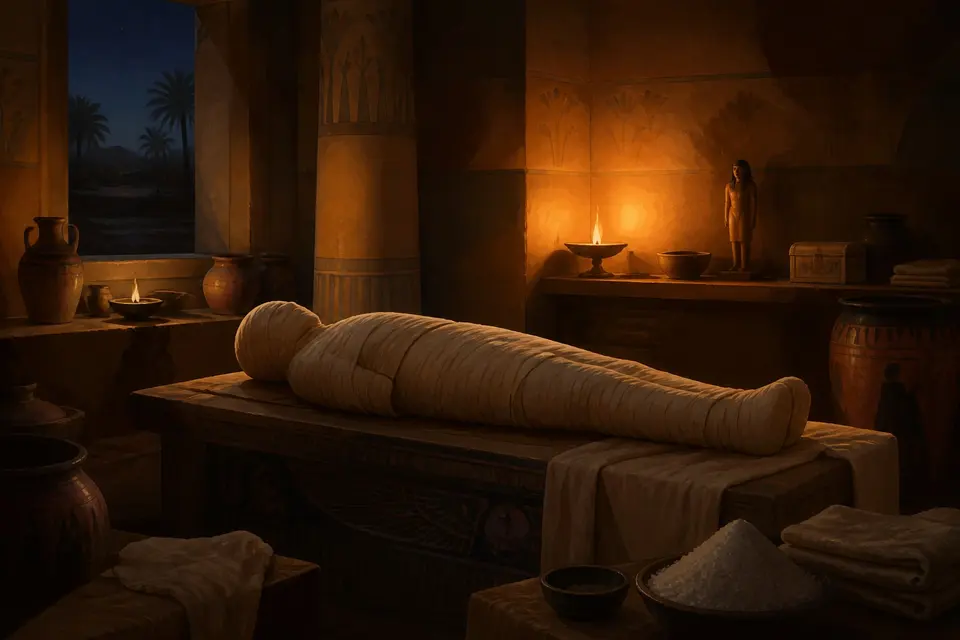
| First (2.86) | Brain drawn out through the nostrils with an iron hook. Abdomen cut open with an "Ethiopian stone" and emptied. Body washed with palm wine and aromatics, steeped in natron for 70 days, wrapped in linen with gum, and put in a wooden human-shaped case. |
| Second (2.87) | Cedar oil injected through the anus, with no incision. Body laid in natron, then the oil dissolved the viscera, leaving skin and bones. |
| Third (2.88) | Belly cleansed with a purge (translations differ) and the body kept in natron for 70 days. |
Herodotus refuses to name the god whose method was best, "him whose name I think it impiety to mention." Later commentators identify that god with Osiris, but that is not in his text. He describes the technique and says nothing of its spiritual meaning. Diodorus Siculus, in the first century BCE, also reports embalming (Book 1, chapter 91).
Egyptian texts exist too. The oldest document on the practice is the medical Papyrus Louvre-Carlsberg (about 1450 BCE), and the most complete ritual text, the Embalming Ritual, survives on two Roman-period papyri (Boulaq 3 and Louvre 5158), probably of the 1st century CE.
When did mummification begin?
This is contested. The old view held that prehistoric bodies were preserved only by hot, dry sand. In 2014, Jones and colleagues reported resin-soaked linen wrappings at Mostagedda (about 4500-3350 BCE), with a recipe they argued resembles later pharaonic ones. Donald Redford is skeptical and knows of no evidence for embalming before the first pyramids. A 2018 study of a Predynastic body in Turin (about 3700-3500 BCE) reported embalming agents, and it extends the same argument for early embalming.
The conventional view is that true mummification starts in the Old Kingdom, about 2500 BCE. Salima Ikram has described early treatment as basic drying, with no brain removal and only occasional removal of organs. That picture is itself under debate.
Where does the word "mummy" come from?
Not from Egyptian. The chain runs from Persian mūm ("wax") to Persian and Arabic mūmiyā ("bitumen," used as medicine), then Medieval Latin mumia, then English. The meaning "preserved body" came after the Middle Ages. The Egyptians called a mummy sah. For the legends that later gathered around opened tombs, see The Curse of the Pharaohs: Where the Legend Really Began.
Why did mummification stop?
The standard museum answer, from the Royal Ontario Museum, is that artificial mummification declined as Christianity spread (2nd-5th centuries CE). Late Roman mummies with stucco shrouds and painted portraits date from the late 3rd to the mid-4th century, so the practice was alive well into Roman rule.
The end date is disputed. Lucarelli, quoted by LiveScience, puts it in the 4th century. Some popular accounts place the end as late as the 7th century, when Egypt came under Islamic rule. The sources do not agree on a single date.
The best ancient evidence is Athanasius's Life of Antony (chapters 90-92, about 360 CE). It says Egyptians were used to wrapping the bodies of good men, especially martyrs, in linen and keeping them on couches in their houses instead of burying them. Antony called the custom neither lawful nor holy, told the bishops to stop it, and asked to be buried in a hidden place. The passage is about wrapping and keeping holy bodies at home, not about removing organs and using natron. It shows church leaders opposing one related custom among Christians, not Christianity abolishing mummification.
None of the sources cited here records a ban. The Edict of Milan (313) legalised Christianity and did not touch burial. The sources describe a gradual change.
What we rely on
Ancient sources
- Herodotus, Histories 2.85-90 (the three embalming grades, 2.86-88; drowned and crocodile victims, 2.90). Translations: A. D. Godley (Perseus Digital Library) and George Rawlinson.
- Diodorus Siculus, Library of History 1.91 (embalming). Loeb Classical Library vol. I (Books 1-2.34), trans. C. H. Oldfather (1933).
- Athanasius, Life of Antony, chapters 90-92 (c. 360 CE).
Modern scholarship
- Jones, J., T. F. G. Higham, R. Oldfield, T. P. O'Connor and S. A. Buckley, "Evidence for Prehistoric Origins of Egyptian Mummification in Late Neolithic Burials," PLoS ONE 9(8): e103608 (2014).
- Salima Ikram and Aidan Dodson, The Mummy in Ancient Egypt: Equipping the Dead for Eternity (Thames & Hudson, 1998).
- Salima Ikram, Death and Burial in Ancient Egypt (Longman, 2003).