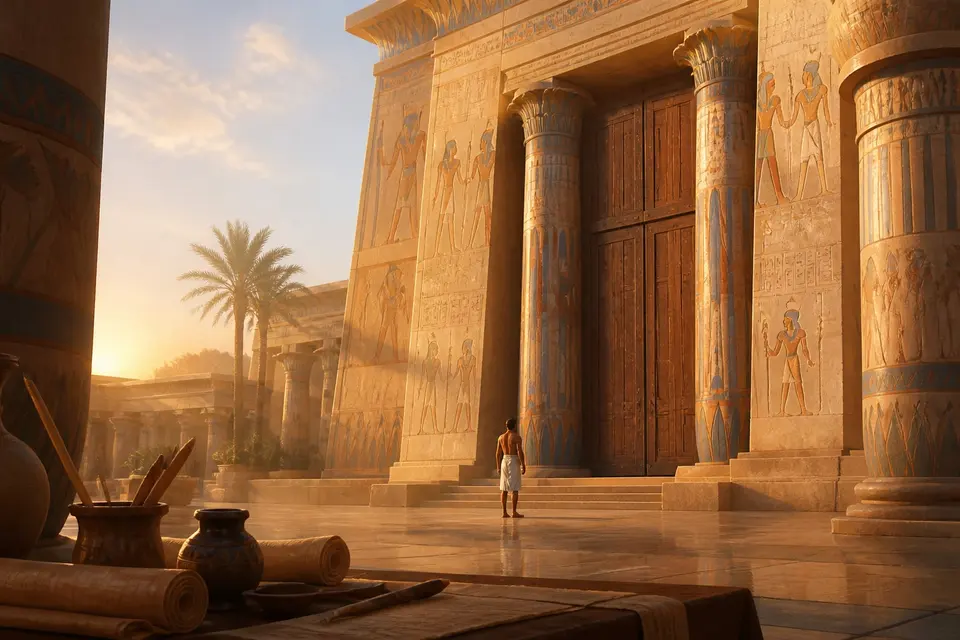
The Egyptian king was called pharaoh because the word comes from pr ꜥꜣ, "Great House", which first named the royal palace. Like "the White House" or "Buckingham Palace", it slid from the building to the person inside, and by the Eighteenth Dynasty it could refer to the king himself.
What does "pharaoh" actually mean?
The Egyptian phrase pr ꜥꜣ is written with the signs for "house" and "column", the column here meaning "great" or "high". It did not begin as a title for a person. In the early evidence it appears only inside longer phrases, such as smr pr ꜥꜣ, "Courtier of the High House", which refers to the court or palace.
An official named Akhethetep, known from his tomb at Saqqara, bore the title "overseer of the great house". He is probably dated to the end of the 5th or the start of the 6th Dynasty. That suggests the phrase was already in use in the Old Kingdom, probably as a term for the palace or royal administration, though the function of his title is unclear. From the Twelfth Dynasty a wish formula, "Great House, may it live, prosper, and be in health", is still about the palace.
How did a palace become a person?
Scholars explain the shift as metonymy: a place standing for the one who rules from it. Shirly Ben-Dor Evian makes the comparison with "White House" in her article on the title. It is a modern analogy, not something an Egyptian wrote.
The earliest confirmed use for the ruler himself is a letter addressed to Akhenaten (about 1353-1336 BCE), which calls him "Great House" with the wish for life, prosperity and health. A use for Thutmose III (about 1479-1425 BCE) is possible, depending on whether an inscription at the temple of Armant refers to that king. That is debated. Popular articles that call Thutmose III "the first pharaoh" state as fact what scholars treat as unconfirmed.
From the Nineteenth Dynasty, pr ꜥꜣ on its own was used as regularly as ḥm, "Majesty". By the 22nd and 23rd Dynasties it was a respectful way to name the ruler.
What did the Egyptians call their king?
Mostly something else. The usual words were nswt, "king", ḥm, "Majesty", jty, "monarch", nb, "lord", and ḥqꜣ, "ruler". A king's throne name was written with the title nsw bity, "King of Upper and Lower Egypt".
The formal royal titulary had five names. It became standard in the Middle Kingdom and stayed in use as late as the Roman Empire. Pr ꜥꜣ never became part of it. It was a way of referring to the king, not his official title.
Only late did it attach to a name. The first dated case is Year 17 of Siamun (10th century BCE) in the Karnak Priestly Annals. A stela from Dakhla Oasis is dated to Year 5 of "Pharaoh Shoshenq, beloved of Amun", which Alan Gardiner published in 1933 and which is taken to be Shoshenq I. By the late Third Intermediate Period, Ben-Dor Evian notes, texts could treat pr ꜥꜣ as worthy of a cartouche, like a throne or birth name.
A female form, pr ꜥꜣ.t, appears in the Ptolemaic period, known only from demotic papyri. It is attested for ruling queens such as Cleopatra VII.
Was Narmer, or Khufu, called pharaoh?
Not in his lifetime. "Pharaoh" is a modern convention applied backwards. Scholars use it for rulers from the First Dynasty (about 3150 BCE) to 30 BCE, though the word is first used for a king only in the Eighteenth Dynasty.
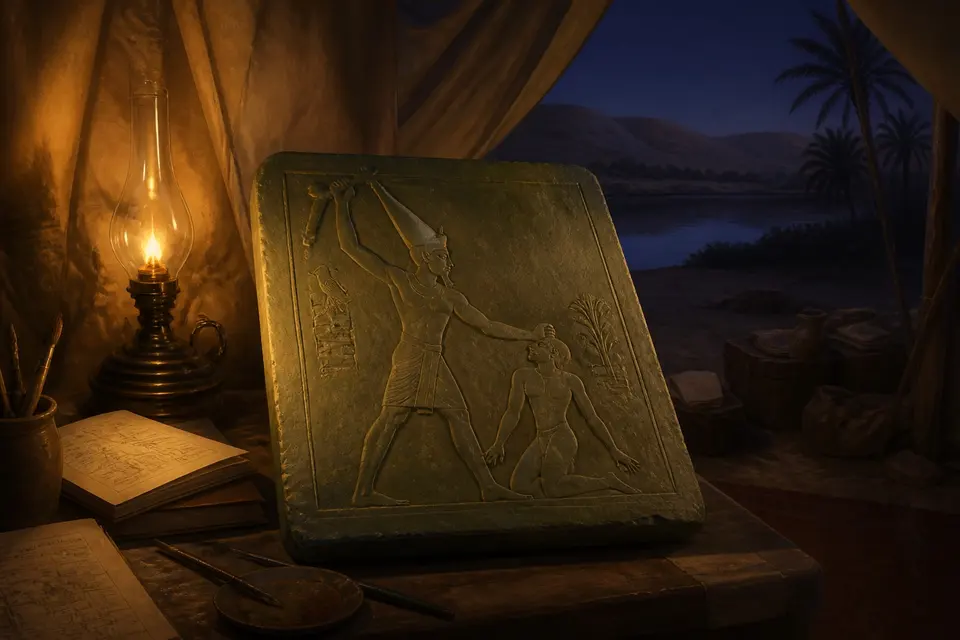
Narmer, for example, is known from contemporary monuments by his Horus name written inside a serekh, a rectangle that is thought to picture a palace facade. Whether he also used another name, or was the Menes of the later king lists, is debated.
The same shorthand sits in the modern phrase "curse of the pharaohs", whose real origins are in The Curse of the Pharaohs: Where the Legend Really Began. For the gods the Egyptians actually worshipped, start with The Egyptian Gods: Who Is Who. For kings and gods in story, see Isis and Osiris: The First Murder Mystery and The Journey to the Afterlife in Egyptian Mythology.
How did the word reach Hebrew, Greek and English?
Hebrew Par'oh is an Egyptian loanword and the usual biblical term for the king of Egypt. It occurs roughly 270 times, about half in the Exodus story and a third in the story of Joseph. The Bible also has the forms Pharaoh Necho and Pharaoh Hophra, which match the Egyptian habit of attaching the word to a name.
The Greek φαραώ preserves a Late Egyptian pronunciation beginning par-. English first had "Pharao", and the King James translators restored the "h" from the Hebrew. Arabic firʿawn ends in -n, a feature that also appears in Greek inflected forms (pharaōn-). The exact route into Arabic, probably through Syriac or Aramaic, is not firmly documented.
The Jewish historian Josephus got it wrong. He wrote that all Egyptian kings from Menes to Solomon were called Pharaohs, that the word means "king" in Egyptian, and that no later king used it. It means "great house", and later kings carried it, as the biblical names above show.
Other old guesses fail too. It does not come from the sun-god Ra, from Hebrew parah, "destroyer", or from Coptic ouro, "king". All of them lose to the plain Egyptian pr ꜥꜣ.
What we rely on
Ancient sources
- Josephus, Antiquities of the Jews 8.6.2: the claim about "Pharaoh" and Solomon.
- Karnak Priestly Annals, Year 17 of Siamun: the first dated "pharaoh" with a king's name.
- Alan Gardiner, publication of the Large Dakhla stela (1933): Year 5 of "Pharaoh Shoshenq, beloved of Amun".
Modern scholarship
- Shirly Ben-Dor Evian, "The Title 'Pharaoh'," TheTorah.com (2016): the change in usage over time.
- Toby A. H. Wilkinson, Early Dynastic Egypt (Routledge, 1999): background on early kingship.