Zeus made Atlas hold up the sky, but the earliest sources, Hesiod's Theogony and Homer's Odyssey, never say why. The common answer, that Atlas led the Titans in war against Zeus, comes from later handbooks and is an inference, not a line in either poem.
What does Hesiod actually say about Atlas?
Hesiod makes Atlas a son of the Titan Iapetus and Clymene, daughter of Oceanus. His brothers are Menoetius, Prometheus and Epimetheus (Theogony 507-511).
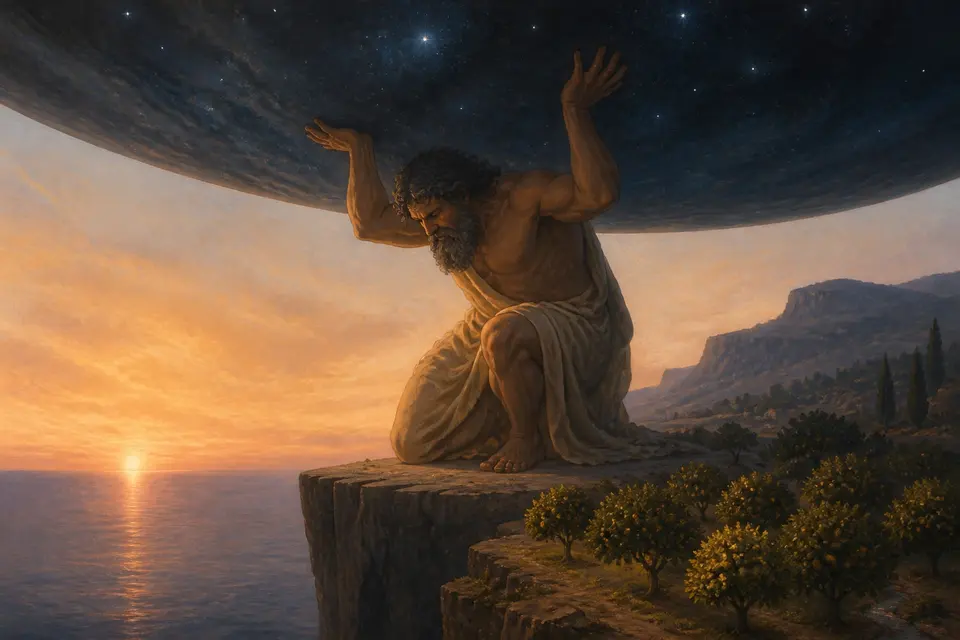
Then comes the key passage (517-520). Atlas holds the wide heaven "through hard constraint," with his head and unwearying arms, at the borders of the earth, in front of the clear-voiced Hesperides. Zeus assigned him this lot. A second passage (744-750) places him before the dread house of Night, where Night and Day greet each other at a brazen threshold.
Hesiod calls it an allotment and a constraint. He does not call it a sentence for any named crime.
Did Atlas fight against Zeus?
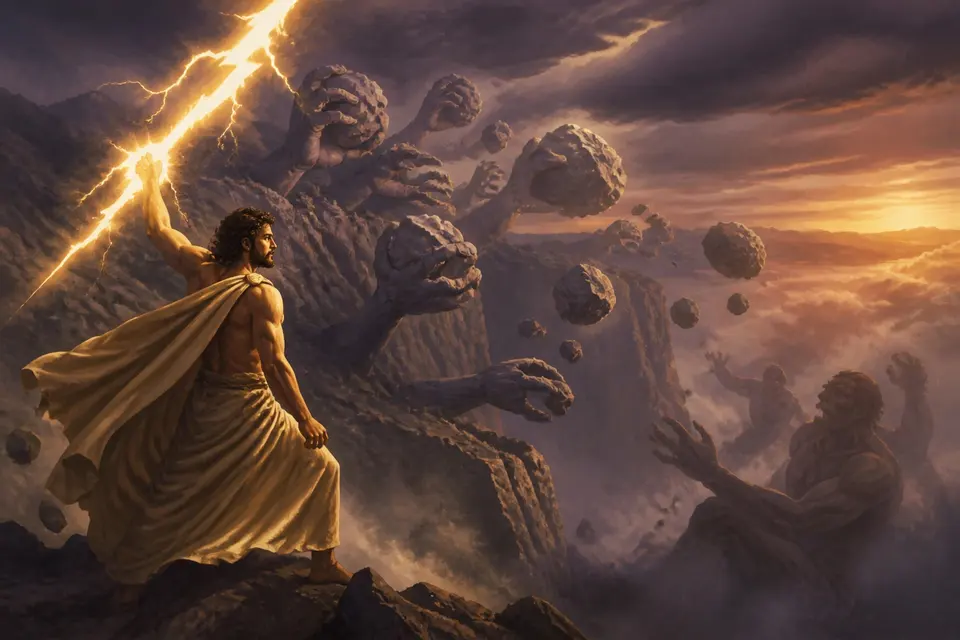
Probably, in the sense that he was a Titan, and the Titans lost. Later handbook tradition says so outright: a nineteenth-century dictionary entry reproduced on Theoi calls Atlas the leader of the Titans against Zeus, conquered and condemned to carry the heavens.
That is a late summary, not an ancient text. Hesiod never describes Atlas in the fighting. So the war-leader explanation is a reasonable reading that later writers turned into a fact. Keep it apart from what the Theogony says.
What do his brothers tell us?
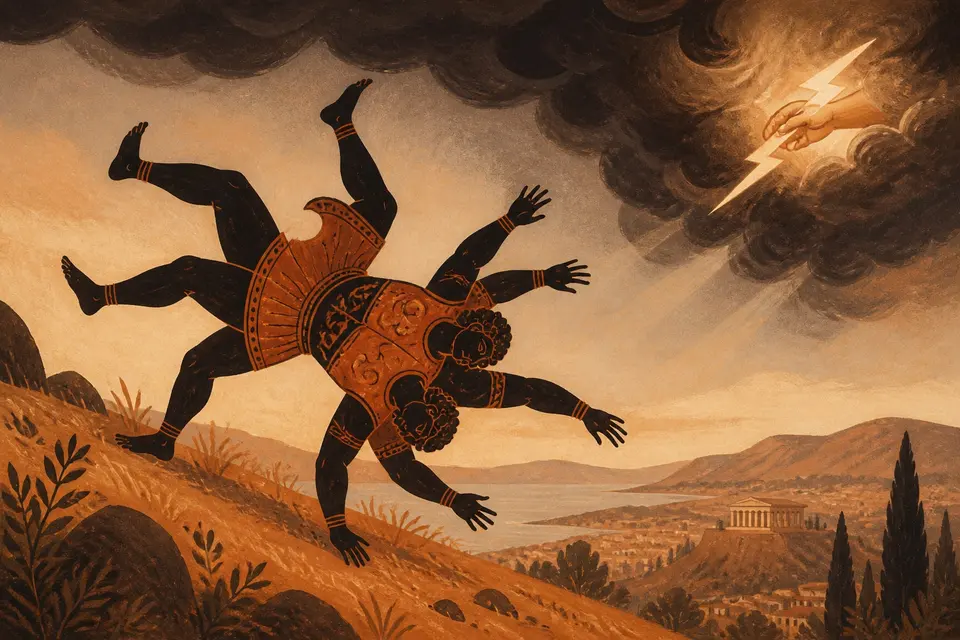
Hesiod lists the sons of Iapetus one after another, and each gets a fate under Zeus. Menoetius is struck by a thunderbolt for his "mad presumption" (hubris) and sent down to Erebus (514-516). Atlas gets the sky. Prometheus is bound, and the story of his theft of fire explains why.
Among the brothers, only Menoetius is explicitly charged with hubris in this passage. Prometheus's offence is told in the lines that follow, and Epimetheus is called a harm to men. Atlas's task is not a copy of his brother's punishment: Menoetius is destroyed, Atlas is put to work. Hesiod adds that Heracles later kills the eagle and frees Prometheus "not without the will of Olympian Zeus," so that the hero's glory grows (526-534). Hesiod says nothing of Heracles relieving Atlas. For the hero himself, see Why Hercules Really Had to Do the Twelve Labors. The newest of the Olympians in this story are introduced in The Twelve Olympian Gods.
Did Atlas hold the Earth on his shoulders?
Mostly not in the ancient sources: Hesiod has him hold the sky, and Aeschylus has him bear the "pillar of heaven and earth" on his shoulders. The modern picture of a man bent under the globe of the Earth is a later blend.
The pose also varies. Hesiod gives head and hands. Homer has a different picture: in the Odyssey (1.52 ff.) Atlas knows the depths of every sea and keeps the tall pillars that hold earth and sky apart, and no reason is given for it. Apollodorus (1.2.3) speaks of Atlas holding the sky on his shoulders, and that is the version most people picture today. Aeschylus (Prometheus Bound 349-352, 427-430) has him bearing the "pillar of heaven and earth" on his shoulders and supporting the vault of heaven.
Even the parents vary. Apollodorus gives Asia as his mother, Ovid names only Iapetus, and Pseudo-Hyginus calls him a son of Aether and Gaia in one place. Hesiod's version is the usual starting point, but the ancient sources did not agree.
Did Perseus turn Atlas to stone?
In Ovid, yes, and Zeus has no part in it. In the Metamorphoses (4.627 ff.), Perseus arrives at nightfall in the kingdom of Atlas. Atlas had been warned that a son of Zeus would steal the golden apples of his garden, so he refuses Perseus shelter. Perseus holds up the head of Medusa, and Atlas becomes the mountain that holds up the sky.
In Ovid the prophecy names only "a son of Jupiter." Atlas fears Perseus, but the prophecy is often read as anticipating Heracles, a later son of Zeus and Perseus's great-grandson. Ovid is a Roman poet writing centuries after Hesiod, and his Atlas is a king, not a punished Titan. An earlier version credited to a poet named Polyidus makes Atlas a shepherd. Its date and attribution are uncertain.
Is Atlas a person or a mountain?
Possibly both. One scholarly view, found in the old dictionary tradition, holds that the story first belonged to a single mountain at the edge of the world. The name later moved to other places: Mauretanian, Italian, Arcadian and even Caucasian "Atlas" ranges. On this reading, the Titan and the mountain are one tradition, later pinned to North Africa. This is one view, not a settled one.
The name itself is unexplained. One proposal links it to a Greek root meaning "to bear," another treats it as pre-Greek, and a Berber derivation from a word for "mountain" is speculative. The "bearer" meaning is a Greek-based guess and should not be taken as fact. The far west where Atlas stands also fits the habit of placing marvels at the edge of the known world, a theme in Why the Planets and Stars Have Mythological Names.
So what is the honest answer?
Zeus gave Atlas the sky. Later tradition explains it as the penalty for leading the Titans in war, and that is likely, but Hesiod does not say it. In Homer Atlas keeps the tall pillars that hold earth and sky apart, with no reason given, and in Ovid Atlas ends as a mountain because of Perseus, not Zeus. The idea of Atlas as a punished rebel is a tidy gloss laid over sources that tell several different stories.
What we rely on
Ancient sources
- Hesiod, Theogony 507-520, 526-534, 744-750. Translation: H. G. Evelyn-White (Loeb Classical Library), online at Perseus (Tufts).
- Homer, Odyssey 1.52 ff. (Atlas and the pillars).
- Apollodorus, Library 1.2.3 (Atlas's mother and the shoulders).
- Ovid, Metamorphoses 4.627 ff. (Perseus and Atlas).
- Aeschylus, Prometheus Bound 349-352, 427-430 (Atlas bearing heaven and earth).
Modern scholarship
- Theoi.com, "Atlas," which reproduces a nineteenth-century dictionary entry.