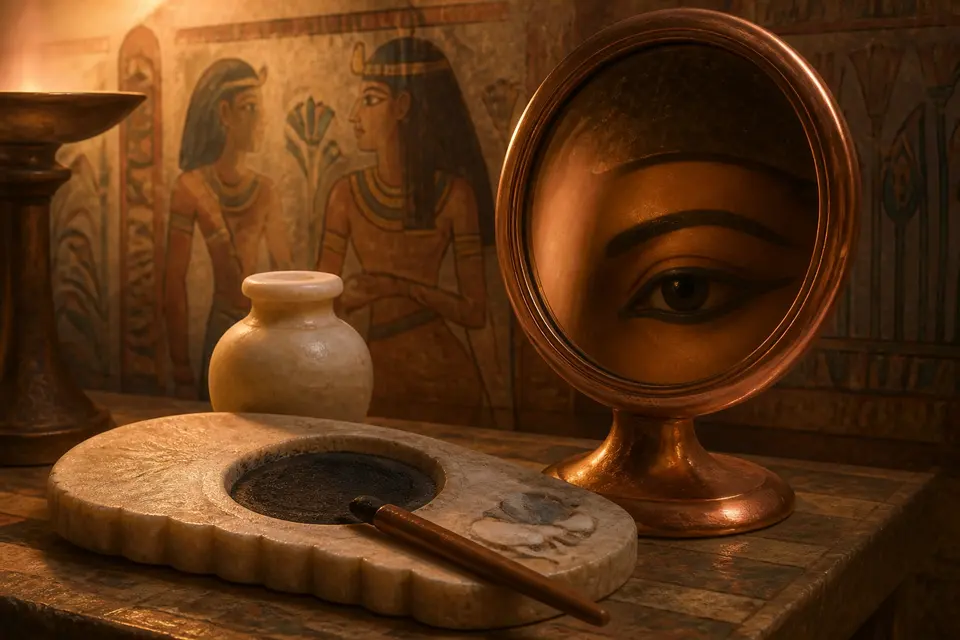
The ancient Egyptians wore eyeliner for more than one reason, and the reasons probably overlapped. It was a cosmetic, it was tied in some beliefs to the protection of Horus and Ra, and it may have helped guard against eye illness. The popular sun-glare explanation remains unproven.
What was Egyptian eyeliner made of?
The Egyptian word for eye-paint, and for black eye-paint in particular, was mesdemet (written msdmt). "Kohl" is a later, Arabic-derived term. Mesdemet passed into Coptic, then into Greek as stimmi and into Latin as stibium.
Green came first. Burial samples from predynastic times (5000-3000 BC) show green kohl, made mainly from malachite, a copper carbonate. In the dynastic periods, kohl often contained galena (lead sulfide) as its most abundant ingredient, which gives a black colour.
Galena was not the whole story. Scientists analysed 52 samples from ancient Egyptian makeup containers in the Louvre and found four lead-based substances: galena, cerussite, phosgenite and laurionite. The last two do not occur naturally in Egypt. The researchers concluded they were deliberately synthesized and ground into fine powders. That conclusion rests on the chemical analysis plus recipes reported by Greco-Roman authors, who wrote later than the pharaonic samples.
Recipes also varied. Research has focused on lead-based ingredients, and organic components are far less studied. Some early analyses found wax, fat, balms or resins in a few specimens, but Lucas and Harris doubt that these were eye-paints rather than other medicinal preparations.
Did eyeliner protect against eye disease?
This is the best-known modern claim, and it needs care. In 2010 a team of chemists, including a researcher from the Louvre's research laboratory, exposed cultured human skin cells (keratinocytes) to low concentrations of lead ions. Very low concentrations stressed the cells, which responded by overproducing nitric oxide, by up to 240 per cent according to the press release.
Nitric oxide stimulates nonspecific immune defences. From this the authors wrote that "one may argue" the lead compounds were made on purpose to prevent and treat eye illness. They also called the manufacture the first known example of a large-scale chemical process, "whether or not" it was tied to preventative health care. Their abstract adds that, according to Egyptian manuscripts, such preparations were essential remedies for eye illness and skin ailments.
The limits are real. The experiment used cultured skin cells (a line named HaCaT), not eye tissue and not Egyptian wearers, and it used lead ions rather than samples of the kohl itself. It does not show that kohl prevented disease. The idea that eye infections were a problem in marshy areas during the Nile flood is context the authors offered, not a finding. And lead is toxic: it can enter the blood through the lungs, the mouth and the skin. The careful wording is "may have," not "did."
Was it protection from the gods?
A summary of the Louvre team's work says some Egyptians believed the makeup had a magical role, with the gods Horus and Ra protecting the wearer against several illnesses. That is a modern summary of a belief, not a quoted Egyptian text.
It fits a wider pattern. Egyptian gods guarded the living and the dead, and the sun god's daily journey was itself a battle against danger (see Ra's Night Journey and the Serpent That Wanted to Stop the Sunrise). For who Horus and Ra are, start with The Egyptian Gods: Who Is Who, and for Horus's family, see Isis and Osiris: The First Murder Mystery. Magic and medicine need not have been separate reasons.
Did it cut the sun's glare?
You will often read that kohl worked like sunglasses. A costume-history book says cosmetics were worn "as protection from the glare of the sun." Other popular sources repeat that kohl may have reduced sun glare. No ancient Egyptian text and no direct experimental test of ancient kohl is known to show this, although some modern papers argue for the effect on the basis of galena's properties. It is a reasonable guess, not an established function.
Was it simply makeup?
Almost certainly in part. Popular summaries say kohl made the eyes look larger and more brilliant, and that wealthier people used better galena kohl while poorer people used soot from almond shells and similar materials. These are not scholarly sources, so the class detail is unconfirmed. The same popular sources say both men and women wore eye makeup, which is generally accepted.
Much of the physical evidence comes from burials and from containers now in museums. For what Egyptians hoped for after death, see The Journey to the Afterlife in Egyptian Mythology.
Is modern Egyptian kohl the same?
Not necessarily. A 2006 analysis (Hardy et al.) found that only about a quarter (22%) of the modern Egyptian kohl samples tested contained a lead compound as a major component. The Louvre study also covers only lead-based samples from one collection, so it cannot stand for all Egyptian makeup.
What we rely on
Ancient sources
- Theophrastus, On Stones, edited and translated by E. R. Caley and J. F. C. Richards (1956): relevant to Greco-Roman recipes for lead compounds.
Modern scholarship
- I. Tapsoba, S. Arbault, P. Walter and C. Amatore, "Finding Out Egyptian Gods' Secret Using Analytical Chemistry: Biomedical Properties of Egyptian Black Makeup Revealed by Amperometry at Single Cells," Analytical Chemistry 82(2), 2010, 457-460.
- P. Walter and others, "Making make-up in Ancient Egypt," Nature 397, 1999, 483-484.
- "Recipes of Ancient Egyptian kohls more diverse than previously thought," Scientific Reports.
- A. Lucas and J. R. Harris, Ancient Egyptian Materials and Industries: the standard reference cited for doubts about organic eye-paints.