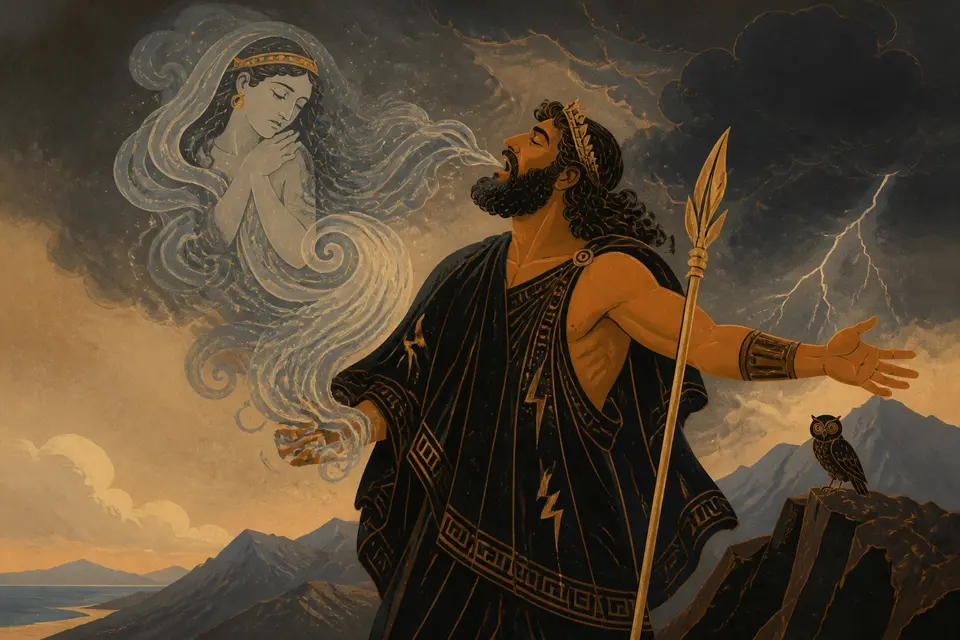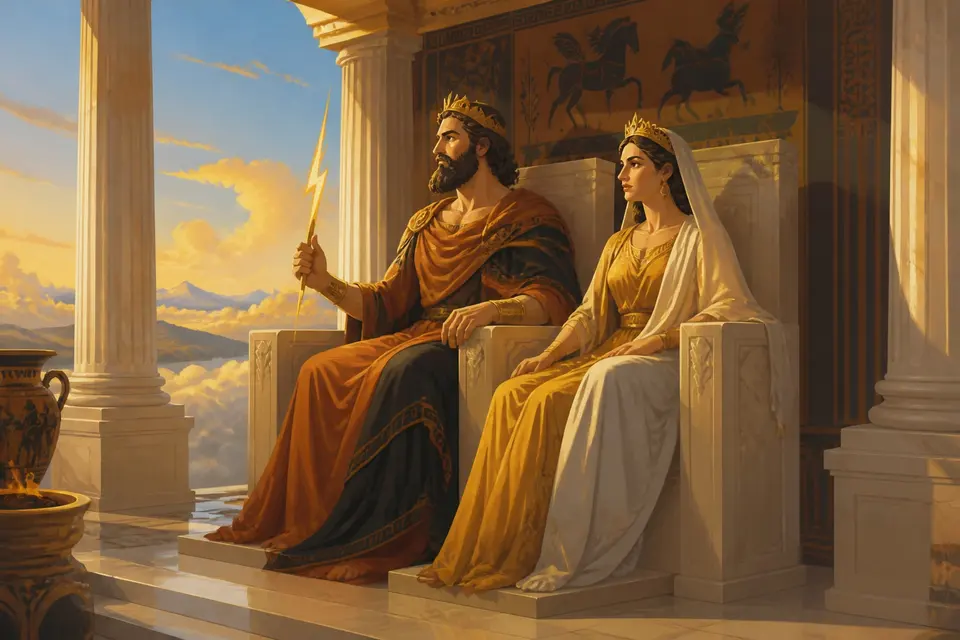
Some Greek gods did marry their siblings, but not all of them. The clearest cases are Zeus and Hera, and the Titans Cronus and Rhea. Other divine couples are better described as uncle and niece, mother and son, or a union without marriage.
Which gods were brother and sister, and husband and wife?
Zeus and Hera. In Hesiod's Theogony (about 700 BCE), Rhea bears Hestia, Demeter, Hera, Hades, Poseidon and Zeus to Cronus, and Zeus is the last of the six (lines 453-458). In Hesiod's list of Zeus's unions, Hera comes last and is the one he makes his wife at the end (921-923).
Homer says it in so many words. The Iliad calls Hera both Zeus's wife and his sister (14.293, 16.432, 18.356). It also calls her the "eldest" daughter of Cronus (4.58). That "eldest" is Homer's. Hesiod only gives a birth order, with Hera third and Zeus last.
In Iliad 14, Zeus remembers when the two first found love, "sleeping together without their dear parents' knowledge". The text is plain. Reading it as a secret sibling affair is an interpretation, though a natural one. For the full family tree, see The Twelve Olympian Gods: Who They Are and How They Are Related.
What about the Titans and the first gods?
Zeus's parents were siblings too. Hesiod lists Rhea among the children of Gaia and Uranus, with Cronus the youngest (132-138), and then has Cronus take her as his wife. The later mythographer Apollodorus says it outright: Cronus "married his sister Rhea".
Modern summaries count four brother-sister marriages among the Titans: Oceanus and Tethys, Coeus and Phoebe, Hyperion and Theia, Cronus and Rhea. It was not a strict rule. Iapetus married his niece Clymene, and Crius his half-sister Eurybia.
Earlier still, Hesiod's Chasm (his word for what is usually translated "Chaos") produces Erebos and Nyx, and Nyx bears Aether and Hemera after a loving union with Erebos. That is a sibling pairing. Gaia's union with her son Uranus, who produces Okeanos and the rest, is a different thing: mother and son.
Homer offers a rival picture. Hera calls Oceanus the origin of the gods and Tethys their mother (Iliad 14.201, 14.302). M. L. West reads this as a myth of "first parents of the whole race of gods", which would make that primordial couple siblings as well. Timothy Gantz counters that "mother" may only reflect Tethys fostering Hera, and the wording may be formulaic. Scholars have not settled it.
Which divine pairings were not sibling marriages?
Zeus did lie with a sister other than Hera: Demeter. But Hesiod says only that Zeus "went to the bed of" Demeter, who bore Persephone (912-914). It is a union, not a marriage. Themis and Mnemosyne, also among his partners, are his aunts in the Titan genealogy, and Leto is no sibling at all.
The marriage of Hades is an uncle-niece one. In the Homeric Hymn to Demeter (7th to 6th century BCE), Zeus gives Persephone to Hades, "his own brother". The story is told in Persephone and the Pomegranate, and Hades himself in Hades Is Not the Devil.
So "the Greek gods married their siblings" is true of some couples and false as a rule.
Did the Greeks treat this as normal for humans?
No. Greek writers kept the gods' behavior apart from human rules.
In the Odyssey (10.1-12), Aeolus, steward of the winds and dear to the immortal gods, has six daughters and six sons married to one another, feasting in their father's halls. He is not an Olympian. Later, the motif turns into scandal. Euripides' lost tragedy Aeolus, produced in Athens before 423 BCE (the exact date is unknown), is partly reconstructed from a papyrus summary. In it, Macareus rapes his sister Canace, Aeolus sends her a sword, and she kills herself. The details of the lost play are debated. Hyginus (Fabulae 238, 242) and Ovid (Heroides 11) also tell of the incest and Canace's death.
Athenian law is hard to pin down. Modern summaries say blood relationship was no bar to marriage except in direct line of descent, and that half-siblings with different mothers could marry. The evidence is thin and mostly late. The best-known case, Cimon and his sister Elpinice, is disputed. Scholars debate whether she was a full or half sister, and the reports may be political slander.
What happened when a real king copied Zeus and Hera?
Ptolemy II of Egypt married his older sister Arsinoe II, probably in 273/2 BCE (some give shortly before 274, or about 275). The marriage followed pharaonic practice, and it shocked Greeks.
The court poet Theocritus defended it in Idyll 17 by comparing the couple to Zeus and Hera. That is a defense of a king, not proof of a Greek custom. The poet Sotades mocked the marriage and was exiled and killed. Accounts of his fate differ, and one says he was thrown into the sea in a lead box.
Was it the same in Egypt?
In Egyptian myth, Isis is the sister and wife of Osiris, and Shu and his twin sister Tefnut are also married. See Isis and Osiris: The First Murder Mystery and The Egyptian Gods: Who Is Who.
Two cautions apply. The Pyramid Texts (about 2350 BCE) show Isis and Nephthys as mourners, and the earliest consistent narrative of the myth is in Diodorus Siculus (1.21) and Plutarch (about AD 120). Also, myth does not show that ordinary Egyptians married siblings. Jaroslav Černý argued that brother-sister marriage was limited to the royal family in most periods. Roman-era census evidence exists, but Sabine Huebner notes its wording does not rule out adopted siblings, and a few scholars doubt biological sibling marriage was common. Hesiod's sibling pairings predate the Ptolemies by centuries, so the Ptolemaic marriages cannot be the source of the Greek myths.
What we rely on
Ancient sources
- Hesiod, Theogony (about 700 BCE), lines 125-138, 453-458, 912-923. Translation: M. L. West, Hesiod: Theogony and Works and Days (Oxford World's Classics, Oxford University Press, 1988). Apollodorus, Library 1 (about 2nd century CE), for Cronus marrying Rhea.
- Homer, Iliad 4.58, 14.201, 14.293, 14.302, 16.432, 18.356, and Odyssey 10.1-12.
- Homeric Hymn to Demeter (7th to 6th century BCE). Online translation: Gregory Nagy.
- Theocritus, Idyll 17 (the comparison of Ptolemy and Arsinoe to Zeus and Hera).
- Plutarch, De Iside et Osiride. Edition and translation: J. Gwyn Griffiths (University of Wales Press, 1970).
Modern scholarship
- Jaroslav Černý, "Consanguineous Marriages in Pharaonic Egypt," Journal of Egyptian Archaeology 40 (1954): 23-29.