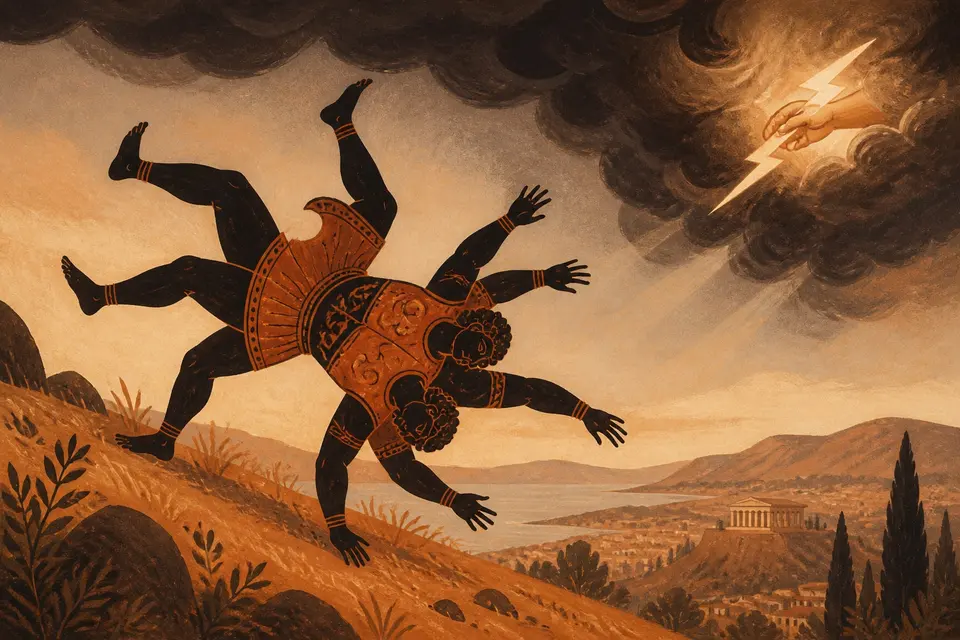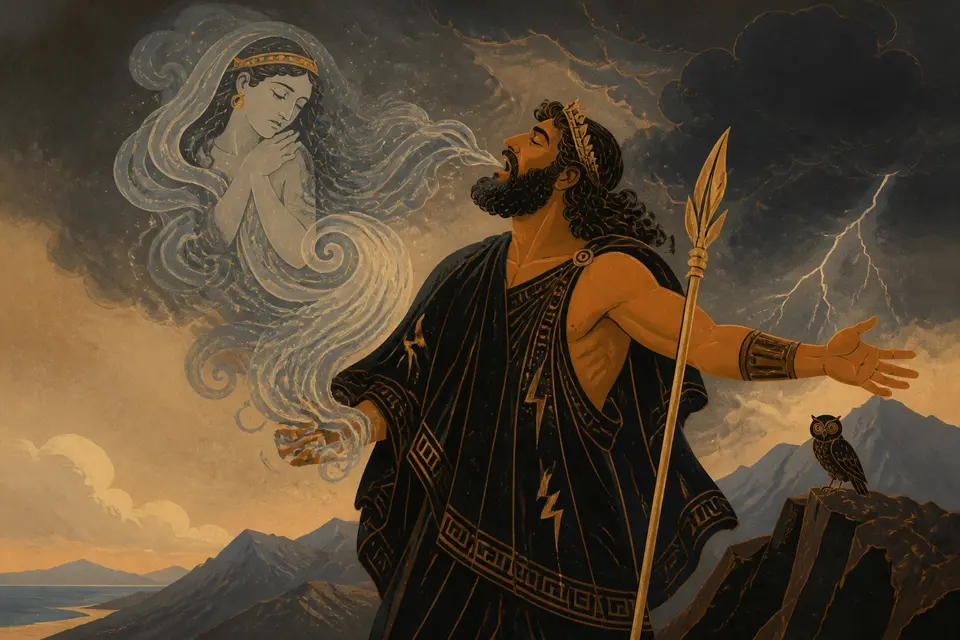
Zeus swallowed Metis, his first wife, to keep the kingship. In Hesiod's Theogony, Earth and Heaven advise him that Metis will bear Athena and then a son who would be king of gods and men. So he puts her inside himself, and she counsels him from there.
Who was Metis?
In the Theogony, Metis is the first wife of Zeus, wisest among gods and mortal men. Themis comes second, and Hera is last. Her name is also a Greek word. Metis means a particular kind of intelligence, an informed prudence, usually glossed as "cunning intelligence." In Homer, Zeus himself carries the epithet Mêtieta, "the Wise Counsellor."
Metis is a goddess of the stories, not of the temples. Detienne and Vernant treat her as a somewhat marginal figure of myth, and no major cult of her is attested. Orphic poems about the beginning of the world give a different Metis, a primordial deity, and that figure is not the wife of Zeus.
What does Hesiod actually say?
Hesiod (Theogony 886-900) says Zeus deceived Metis with cunning words and put her into his belly, as Earth and starry Heaven advised. The stated reason is that no other god should hold royal sway in his place. The advice rests on a prophecy in two stages. Metis was fated to bear first Athena, equal to her father in strength and wisdom, and afterwards a son of overbearing spirit, who would be king of gods and men.
Hesiod gives a second purpose in the same passage. Zeus swallowed her so that the goddess might devise good and evil for him from inside his body. Later, Zeus gives birth to Athena from his own head (Theogony 924-926), and Hesiod calls her the awful, strife-stirring host-leader.
"Overthrow" is not Hesiod's word. It is a reasonable reading, because the poem has already shown a son taking power from a father twice, Uranus to Cronus and Cronus to Zeus. But Hesiod says only that the son would be king. Hesiod also does not mention an axe or a headache.
Does Apollodorus tell it differently?
Yes. Apollodorus, in the Library (1.3.6), names Earth alone as the source of the warning. Metis changes into many shapes to avoid the embraces of Zeus. Earth says that after the maiden in her womb, Metis will bear a son who would be lord of heaven. The Library is a compilation generally dated to the 1st or 2nd century AD, so it is a late witness, though it preserves older material.
Apollodorus also gives Metis a bigger role earlier. In 1.2.1 she gives Cronus a drug that makes him disgorge his swallowed children. Hesiod credits that plan to Gaia and never mentions Metis there. For more on the god who owed his throne to such schemes, see The Twelve Olympian Gods: Who They Are and How They Are Related.
What about the thunderbolt, the axe and the second version?
The popular fear that Metis might bear a child stronger than his thunderbolt is not in the core Theogony lines. It comes from a second version of 19 hexameters, claimed as Hesiod's and quoted by the Stoic Chrysippus, whose text survives in Galen. It is Hesiod fr. 343 in Merkelbach and West's Fragmenta Hesiodea, and editions such as Evelyn-White's print it after Theogony 929 as lines 929a-t. Whether Hesiod wrote it is debated.
That version differs in details. Zeus swallows Metis first, and she becomes pregnant afterward. She stays hidden beneath his inward parts, still the mother of Athena. In the Theogony and Apollodorus, she is already pregnant when swallowed.
The axe is also later than Hesiod. Pindar (Olympian 7) has Hephaestus split the head of Zeus with a bronze axe, while Athena cries aloud and Heaven and Mother Earth tremble. Apollodorus says Prometheus or, as others say, Hephaestus. Euripides (Ion) names Prometheus. Frazer's note on Apollodorus lists Palamaon and Hermes as other candidates. If you know Prometheus from other myths, see Prometheus: The Titan Who Stole Fire (and Inspired Frankenstein). The Homeric Hymn to Athena (28) simply has her spring from the head in flashing golden armour.
Modern retellings in which Metis hammers armour inside the skull of Zeus are not found in Hesiod. They belong with Why Greek Myths Are Being Retold Right Now.
What do scholars make of it?
Detienne and Vernant argue that Zeus is king because he is, above all, the god who possesses metis. They read the swallowing as Zeus absorbing metis into himself, so that cunning intelligence became part of his sovereignty. This is a structural reading of the myth. Hesiod does not state it.
M. L. West places the episode in a wider setting. He sees Athena's birth as a "reduplication of the Cronus motif," and thinks the Greek succession story was shaped by the Hurro-Hittite Kingship in Heaven cycle, where Kumarbi swallows the genitals of Anu. In this view the swallowing of a pregnant mother is a reworking of that older scene. Many scholars, including West, treat the swallowing of Metis as the point at which the Theogony's cycle of violent succession ends. Others stress that Metis herself remains a threat Zeus has to neutralise.
In the Homeric Hymn to Apollo, Hera bears Hephaestus in anger because Zeus had borne Athena from his head. For the fate side of the story, see The Three Fates Who Even Zeus Obeyed. For Athena's later career, see The Real Story of Medusa.
What we rely on
Ancient sources
- Hesiod, Theogony 886-900 (Zeus and Metis) and 924-926 (Athena's birth). Edition and translation: Glenn W. Most, Theogony, Works and Days, Testimonia, Loeb Classical Library 57 (Harvard University Press, 2006).
- Hesiod fr. 343 (Theogony 929a-t), quoted by Chrysippus in Galen, On the Doctrines of Hippocrates and Plato 3.8. Fragments: R. Merkelbach and M. L. West, Fragmenta Hesiodea (Clarendon Press, 1967).
- Apollodorus, Library 1.2.1 and 1.3.6. Translation with notes: J. G. Frazer.
- Pindar, Olympian 7.35-38 (the axe).
Modern scholarship
- Marcel Detienne and Jean-Pierre Vernant, Cunning Intelligence in Greek Culture and Society, translated by Janet Lloyd (Harvester Press, 1978).
- M. L. West, Hesiod: Theogony (Clarendon Press, 1966): the standard commentary.