No ancient writer says why Zeus married his sister Hera. Hesiod, our earliest full account, simply lists her as the last of Zeus's wives and gives no reason. Any "why" is modern interpretation, and the surviving stories mostly show the marriage after it has begun.
Does any ancient source explain the marriage?
No. In the Theogony (921-923), Hesiod writes that Zeus "lastly" made Hera "his blooming wife," and that she bore Hebe, Ares and Eileithyia. There is no courtship, no motive and no comment on the fact that she is his sister. The marriage is the final item in a list of unions.
So when a website gives you a confident reason, it is offering a modern reading. For the wider family, see The Twelve Olympian Gods: Who They Are and How They Are Related.
Was Hera his first wife?
No. Hesiod places her last, as the seventh wife, after Metis, Themis, Eurynome, Demeter, Mnemosyne and Leto. Demeter, for instance, is the wife who bears Persephone (see Persephone and the Pomegranate).
You may also see Hera called Zeus's "third wife." Hesiod does not say that. He lists Hera last, after Metis, Themis, Eurynome, Demeter, Mnemosyne and Leto.
Did Zeus and Hera get along?
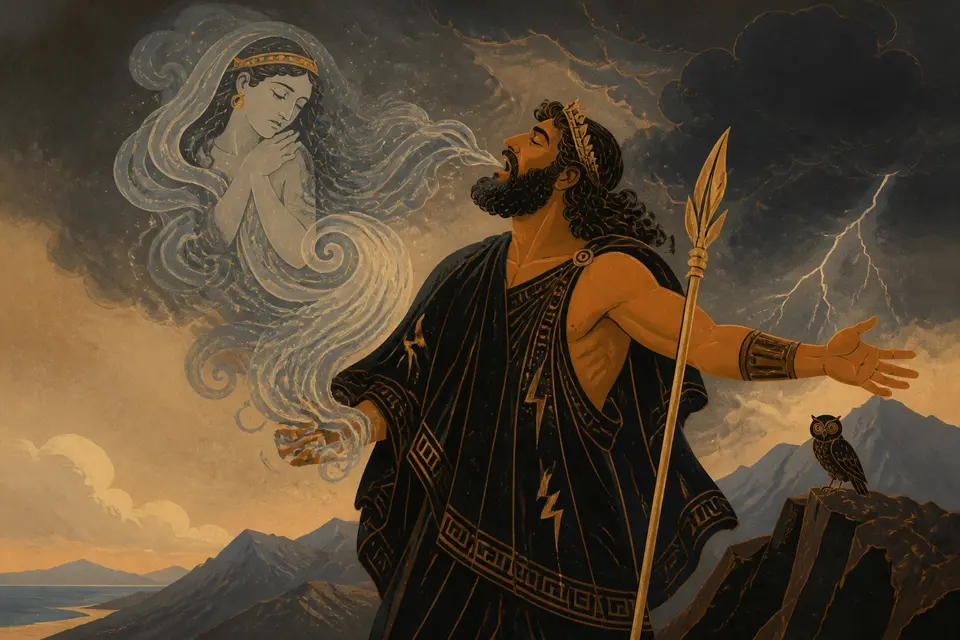
Hesiod already hints at trouble. In the same passage, he says Hera bore Hephaestus without Zeus, "very angry and quarrelled with her mate." Right beside it, Zeus himself produces Athena from his head. It reads like two partners answering each other's births with their own.
This is not the only version. In Homer, Hephaestus calls Zeus his father (Iliad 1.571-579), which makes Hesiod's account the outlier.
What is the Plataean wedding festival?
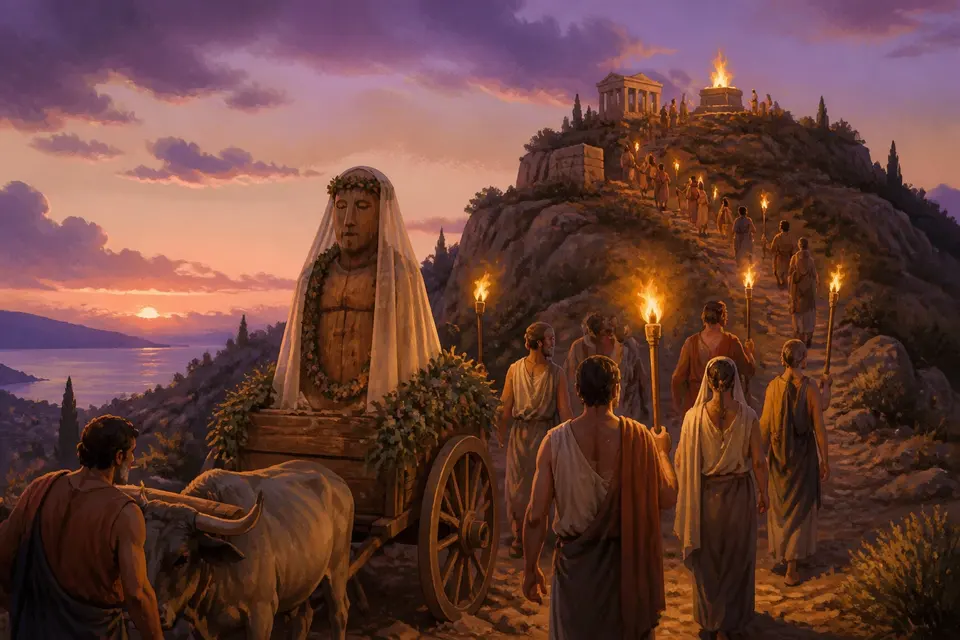
The best-known marriage story is a quarrel mended, told by Pausanias (9.2.7-9.3.9). Hera, angry with Zeus, withdrew to Euboea, and he could not talk her round. He went to Cithaeron, the ruler of Plataea, who was famed for his cleverness. Cithaeron told him to make a wooden image, carry it wrapped in a dress on a bullock wagon, and announce that he was marrying Plataea, daughter of Asopus.
Hera came, tore the dress off the image, found wood instead of a bride, and was so pleased at the trick that she made peace. The festival Daedala commemorates this, because daedala was the old word for wooden images. A nineteenth-century dictionary reports that Plutarch told a variant in which the adviser is Alalcomenes. That version is known only secondhand.
This story cannot answer why Zeus married Hera. It presupposes that they are already married. It is about winning a wife back.
Pausanias also gives the festival's rhythm. The Plataeans hold the Little Daedala alone. The Great Daedala is shared with the Boeotians and held at intervals of fifty-nine years. The cities and their magistrates sacrifice a cow to Hera and a bull to Zeus, burning the victims on the altar together with the wooden images. The ritual is, in effect, a staged wedding procession.
Is there a story of how their love began?
There is a fragment of one, and it comes from Argos, not Plataea. Pausanias (2.17.4) explains the cuckoo on the sceptre of Hera's statue at the Argive Heraeum. Before the marriage, Zeus loved Hera and turned himself into a cuckoo, and she caught the bird as a pet.
The cuckoo story is one ancient fragment of how their love began. Other traditions, such as Iliad 14.295-296, which says they first lay together in secret, also exist. None of these gives a reason for the marriage.
Pausanias 2.17.4 says nothing about Hera's feelings. Some retellings add details such as shame or reluctance, and these need to be checked against the ancient sources one by one. Do not mix this story with the Plataean one, which is a different place and a different tale.
What do modern writers add?
Some modern writers speak of a "sacred marriage" of Hera and Zeus in cult, a ritual enactment of the wedding. The surviving evidence for this is fragmentary. The Plataean festival is the clearest case, and even there Pausanias reports only wooden images burned with sacrifices. Reading the burning as an echo of a Bronze Age rite is a modern inference, not something the ancient text states.
Smith's dictionary gives Hera the Plataean cult titles Nympheuomene ("bride") and Teleia, citing Pausanias. Smith's citation is 9.2.5, while the titles are usually cited to 9.2.7. For why the retelling of these myths never stops, see Why Greek Myths Are Being Retold Right Now.
Hera is a Greek goddess with her own cult and stories. Roman religion has its own tradition, and the question of how the two pantheons relate is handled in Greek and Roman Gods, Side by Side. Zeus also had a major festival of a different kind, described in The Ancient Olympics Were a Festival for Zeus.
What we rely on
Ancient sources
- Hesiod, Theogony 886-929, especially 921-929 (Hera as last wife, the birth of Hephaestus). Translation: Hugh G. Evelyn-White.
- Pausanias, Description of Greece 9.2.7-9.3.9 (the Plataean Daedala) and 2.17.4 (the cuckoo at the Argive Heraeum).
- Homer, Iliad 1.571-579 (Hephaestus names Zeus as his father) and 14.295-296 (Zeus and Hera first lie together in secret).
Modern scholarship
- William Smith (ed.), A Dictionary of Greek and Roman Antiquities, entry "Daedala" (nineteenth century): a summary of the festival, including the Plutarch variant and Hera's Plataean cult titles.