In the ancient sources Zeus takes a disguise to reach a woman he could not simply approach: a bull for Europa, a swan for Leda, a stream of gold for Danae. No ancient text gives one stated purpose. The disguise works as deceit, and in some versions as force.
What does Zeus do as a bull in the Europa story?
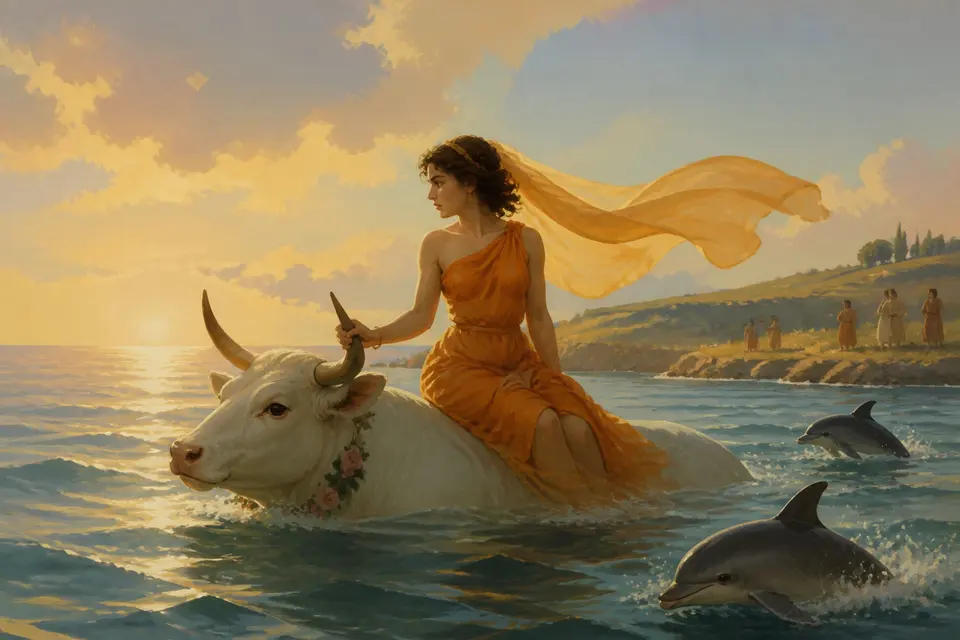
The most detailed surviving early telling is Moschus' Greek poem Europa (about 150 BC). The best-known Latin telling is Ovid's, in which the god is called Jupiter (see Greek and Roman Gods, Side by Side for why the two names are not interchangeable). In Metamorphoses 2.833-875 he hides his motive, even from the reader. He sends Mercury to drive the royal cattle toward the shore where Europa plays, sets aside his sceptre and joins the herd as a bull. The bull is white, mild-looking and unthreatening. Europa touches him, then climbs on his back without knowing who he is.
Ovid stops at the crossing of the sea. Jupiter reveals himself only in Crete (3.1), and the union itself is not narrated. Europa becomes the mother of Minos, whose island is the setting of The Minotaur and the Real Labyrinth of Knossos.
Ovid was not the first. Hesiod, Stesichorus, Simonides and Bacchylides had already treated the myth. The Hellenistic poet Moschus of Syracuse (mid-2nd century BC) wrote a short, witty poem on it in four scenes. The Loeb introduction thinks his dream of two continents struggling over Europa is probably his own invention.
Is the swan story as clear?
Less clear. In Euripides' Helen, the heroine's opening speech reports the swan as hearsay: there is a story that Zeus flew to Leda in the shape of a swan. In David Kovacs' Loeb translation, a further clause says he was fleeing an eagle and took her by treachery. It sits in square brackets, so it should not be leaned on. The same play has Helen name Tyndareus as her father.
Ovid's Helen, in Heroides 17, writes to Paris that Leda made Jove her father, deceived by a false bird she held in her trusting bosom.
The details move around. Hyginus (Astronomica 2.8) puts the eagle chase in the story of Nemesis: Zeus becomes a swan and has Aphrodite chase him as an eagle, so that he can take refuge with her. He adds that others say it was Leda. Apollodorus (Library 3.10.7) preserves a variant in which Nemesis flees Zeus as a goose, he follows as a swan, and a shepherd gives her egg to Leda, who keeps it in a chest until Helen hatches. Pausanias reports that the egg was shown to visitors in Sparta in the 2nd century AD. So Helen's mother is Leda or Nemesis, depending on who tells it, and the story of Helen leads straight to The Apple of Discord and Was the Trojan War Real?.
What about Danae and the golden shower?
Apollodorus (Library 2.4.1, usually dated to the 1st or 2nd century AD) says an oracle warned Acrisius that his daughter's son would kill him, so he locked her in a bronze chamber underground. Some say Proetus seduced her. Others say Zeus came in the shape of a stream of gold through the roof into her lap. Apollodorus offers the gold as one version only, and the rival one has no divine father.
Ovid speaks of a golden shower (Metamorphoses 4.607 ff., 6.113 ff.), and Hyginus (Fabulae 63) says Jupiter changed himself into one. The son is Perseus, who goes on to the adventure in The Real Story of Medusa. In the Iliad (14.319-320) Zeus lists Danae among the women he has loved, but the lines quoted do not describe a disguise.
What are the disguises for?
The table sets out what the form does in each text.
| Woman | Form | What the form does in the text |
|---|---|---|
| Europa | White bull | His mildness makes her touch him and sit on his back (Ovid) |
| Leda | Swan | Deceit and treachery (Euripides, Ovid); details vary |
| Danae | Stream of gold | Gets past the bronze chamber (Apollodorus) |
For Danae, the gold getting past the bronze chamber is the logic of the story, not a motive any source states. Modern websites often say the real reason was to hide from Hera's jealousy. No ancient passage says so. For Hera's place in the family, see The Twelve Olympian Gods.
Is this seduction or assault?
It depends on the source, and scholars disagree. Europa is carried off by a god who hides who he is. Leda is deceived, and in the Nemesis variant the goddess changes shape to escape Zeus and he eventually catches her. Apollodorus calls the Danae episode intercourse and also offers the Proetus alternative. One academic study of metamorphosis and sexual violence argues that modern ideas of consent are hard to apply to these ancient narratives. "Deception, and in some versions force" is the safest summary; not every version shows rape.
Later art shows the same split. Greek artists showed Europa and the bull from at least the 7th century BCE, and the subject was well established by the 6th, appearing on metopes from the Sicyonian Treasury at Delphi (about 560 BCE) and from Selinus, where museums date one small metope anywhere between 580 and 550 BCE. A vase in Tarquinia is about 480 BCE. Leda was also popular in sculpture, pottery and mosaic. Renaissance images are a different matter: Leonardo's lost Leda, known from copies by his followers, shows her embracing the swan, while Titian's Europa is read by some as emphasising helplessness. Those are modern readings, not ancient evidence. Retellings today keep returning to these questions, as in Why Greek Myths Are Being Retold Right Now.
What we rely on
Ancient sources
- Ovid, Metamorphoses 2.833-875, 3.1, 4.607 ff., 6.113 ff.; Heroides 17.
- Euripides, Helen 16-21, 259. Edited and translated by David Kovacs, Loeb Classical Library 11 (Harvard University Press, 2002).
- Moschus, Europa, Loeb Classical Library 28 (introduction).
- Apollodorus, Library 2.4.1, 3.10.7.
- Hyginus, Astronomica 2.8; Fabulae 63.
Modern scholarship
- Clemente Marconi, Temple Decoration and Cultural Identity in the Archaic Greek World: The Metopes of Selinus (Cambridge University Press): the Selinus metopes.