No, the Greek gods had no last names. They had one personal name, sometimes a patronymic such as Kronides ("son of Cronus"), and above all epithets: a second word, like Polias or Horkios, that told you where or in what role a god was being worshipped.
Did ordinary Greeks have last names?
Not in the modern sense. A Greek was usually identified by a personal name and a patronymic, and in formal contexts by the deme, the local district, to which he belonged: Alcibiades son of Kleinias, of the deme Skambonidai. Demes took on real importance in Athens in 508 BC, when enrolment on a deme list became the requirement for citizenship. A common claim says Cleisthenes made the deme name replace the patronymic. It rests on Aristotle's Athenaion Politeia 21.4, which says he had demesmen call each other by deme so that new citizens would not be identified by their fathers' names. Scholars debate how far this was a mandate, and the patronymic stayed in formal use.
Gods were named on a different pattern. They had no deme and no family name passed down to children.
What did the gods have instead?
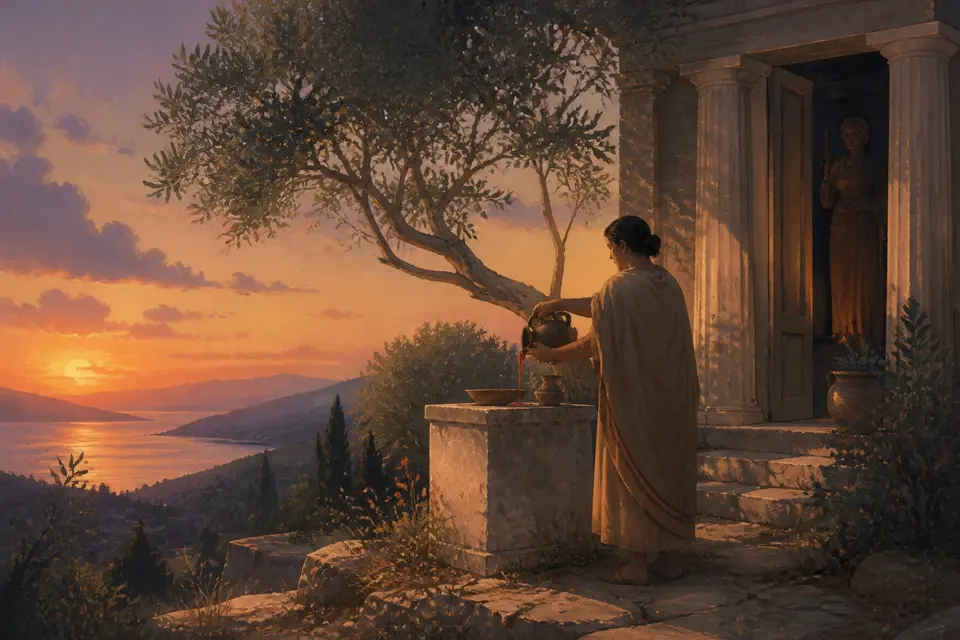
The best scholarly frame comes from Robert Parker, who describes the "cultic double name": a god was mostly called by his or her own name plus an epithet. The epithet might be local ("of Brauron") or functional ("of oaths").
Older English books often call these epithets "surnames". Smith's Dictionary and the Theoi translations do, and that habit may explain why people ask the question. The Greek practice is closer to a title than to a family name.
Which epithets were used in worship?
Many cult epithets are place names. Apollo Delios is Apollo as worshipped on Delos, a different figure in cult from the Apollo of Delphi. Zeus Lykaios is "of Mount Lycaeus" and Zeus Dodonaios "of Dodona". Local titles could also travel: Zeus Olympios was worshipped across Greece, and the sources gloss the name both as "of Olympia" and as "of Mount Olympus", so its origin is debated. (The god's role at the games is told in The Ancient Olympics Were a Festival for Zeus.)
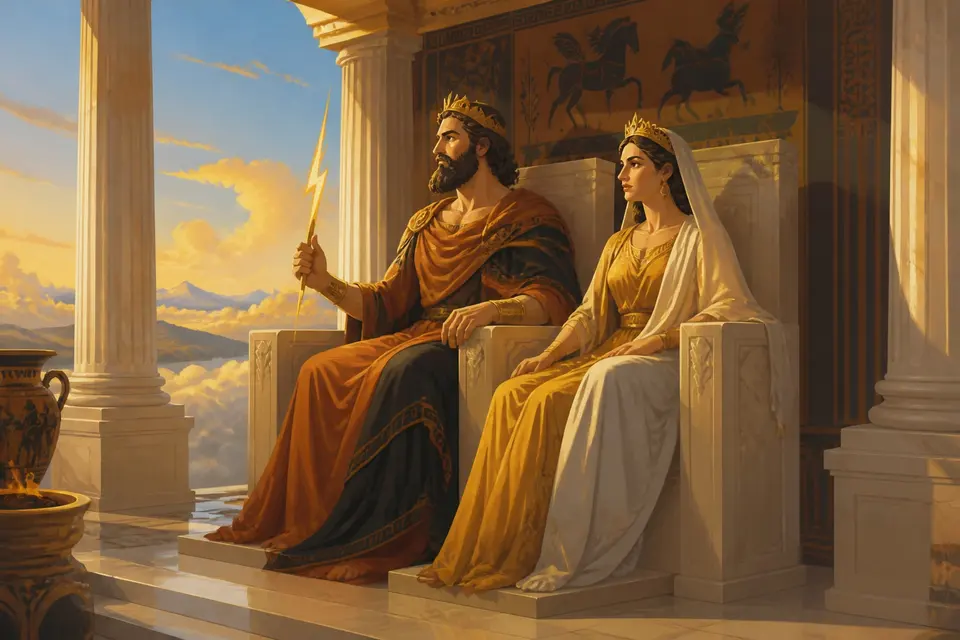
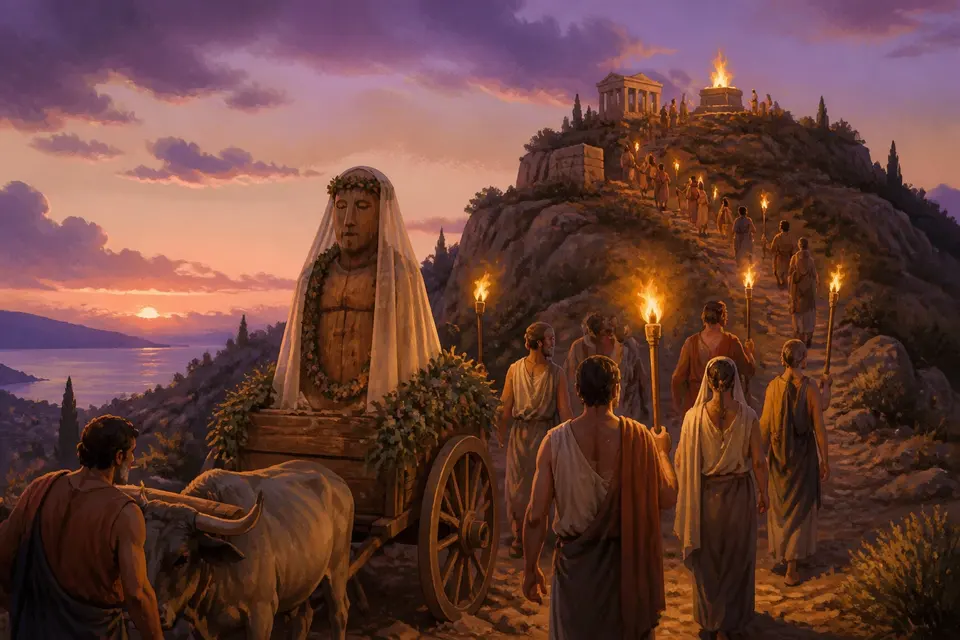
Other epithets name a function. Athena Polias, "of the city", was the protectress of the Athenian Acropolis. The title belonged to a sanctuary and an ancient olive wood image that the Athenians believed Zeus had sent from the sky, and the names of many of her priestesses survive in inscriptions, including the long-serving Lysimache. Zeus Horkios, the Oath-god, stood in the Council Chamber at Olympia with a thunderbolt in each hand; Pausanias (5.24.9) says this was the image most likely to terrify sinners.
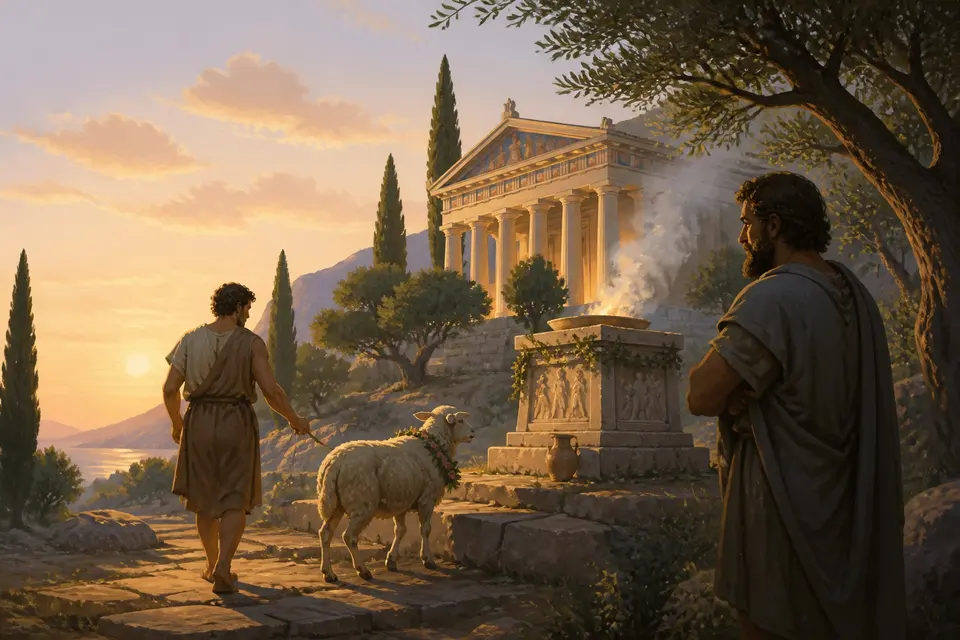
Some epithets were meant to soothe. Zeus Meilichios, honoured at the Attic festival called the Diasia, has a name Parker renders roughly as "who can, but needs to, be propitiated". It is a polite name for a god one would rather not anger. In the same spirit, Sophocles calls Hades Zeus chthonios, "of the earth", and Aeschylus calls him Zeus allos, "another" (see Hades Is Not the Devil).
Which titles were only poetry?
Not every epithet in Homer was a title used in worship. The Oxford Classical Dictionary tells readers to separate purely literary, especially epic, ornaments from epithets known in cult. There is no proof that anyone addressed Athena in ritual as "grey-eyed". It is her stock Homeric epithet, and in epic such a phrase often fits the verse rhythm together with the name.
| Name | What it is | Cult title? |
|---|---|---|
| Kronides, Kronion | Patronymic of Zeus, from Cronus plus the suffix -ides (Iliad 1.498; Odyssey 1.45) | No evidence; it is Homeric and epic |
| Phoibos, "bright" or "pure" | Both a name and epithet of Apollo (Iliad 1.43) | Phoibos Apollon is Homeric; "Phoebus Apollo" is a later literary pairing |
| Pallas | Epithet of Athena with an obscure origin | No instance known in cult |
Two of these deserve a note. In Homer, Kronides and Kronion are used of Zeus. For Pallas, a fragment attributed to Epicharmus says Athena took the name from a slain Giant called Pallas, and Apollodorus tells the same story. No example of the name in cult is known. As for Phoibos, the link between Apollo and the sun is a later development, and the ancient explanations of the name, one of which derives it from his grandmother Phoebe, remain debated.
Did the titles change over time?
Yes. Epithets multiplied, and their function shifted. Parker notes that in the Hellenistic period, epithets that could apply to several gods, such as "Saviour", grew in importance. Zeus Soter is attested in several places, including Thespiai and Messenia in Pausanias. Hundreds of cult epithets of Zeus survive.
Are names like Demetrios a god's surname?
No. Names such as Demetrios are built from a god's name, but people were not usually given the exact name of a god. They are human names that honour a deity, not a shared family name. For the gods' actual family tree, see The Twelve Olympian Gods: Who They Are and How They Are Related. For how the Romans handled the same gods, see Greek and Roman Gods, Side by Side.
What we rely on
Ancient sources
- Homer, Odyssey 9.270-271 (Odysseus on Zeus as protector of strangers and suppliants; the title Xenios is a later label for this function) and Iliad 1.43, 1.498.
- Pausanias, Description of Greece 5.24.9 (Zeus Horkios at Olympia). Translation: W. H. S. Jones.
- Aristotle, Athenaion Politeia 21.4 (Cleisthenes and the demes).
Modern scholarship
- Robert Parker, Greek Gods Abroad: Names, Natures, and Transformations (University of California Press, 2017), chapter 1, "Names and Epithets".
- The Oxford Classical Dictionary, entries "epithets, divine" and "Cleisthenes".
- William Smith (ed.), A Dictionary of Greek and Roman Biography and Mythology.